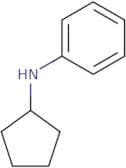
CAS 40649-26-1
:N-Cyclopentylbenzenamine
Description:
N-Cyclopentylbenzenamine, with the CAS number 40649-26-1, is an organic compound characterized by the presence of both a cyclopentyl group and an aniline moiety. This compound features a cyclopentyl ring attached to the nitrogen atom of the amine, which is further connected to a phenyl group. The structure imparts unique physical and chemical properties, including moderate solubility in organic solvents and potential reactivity due to the amine functional group. N-Cyclopentylbenzenamine may exhibit basicity typical of amines and can participate in various chemical reactions, such as nucleophilic substitutions and coupling reactions. Its applications may extend to the synthesis of pharmaceuticals, agrochemicals, or as an intermediate in organic synthesis. Safety data should be consulted for handling and exposure guidelines, as amines can be irritants and may pose health risks. Overall, N-Cyclopentylbenzenamine is a compound of interest in both academic and industrial chemistry contexts.
Formula:C11H15N
InChI:InChI=1/C11H15N/c1-2-6-10(7-3-1)12-11-8-4-5-9-11/h1-3,6-7,11-12H,4-5,8-9H2
InChI key:InChIKey=WEULTTCXSOUGPM-UHFFFAOYSA-N
SMILES:N(C1=CC=CC=C1)C2CCCC2
Synonyms:- Aniline, N-cyclopentyl-
- Benzenamine, N-cyclopentyl-
- Cyclopentyl-phenyl-amine
- N-Cyclopentyl-N-phenylamine
- N-Cyclopentylbenzenamine
- Phenylcyclopentylamine
- N-Cyclopentylaniline
- N-Cyclopentylaniline
Sort by
Purity (%)
0
100
|
0
|
50
|
90
|
95
|
100
Found 3 products.
N-Cyclopentylaniline
CAS:N-Cyclopentylaniline is a chemical compound that is used to control pests. It has been shown to be effective as an anti-inflammatory in inflammatory pain and inflammatory diseases. N-Cyclopentylaniline also has hypotensive properties, which may be due to its ability to block the action of the enzyme phosphodiesterase 4, preventing the breakdown of cyclic AMP. This leads to vasodilation and reduced blood pressure, which can result in a decrease in heart rate. The drug has been shown to have receptor agonism effects on cannabinoid type 1 and 2 receptors, which are associated with chronic pain relief.
Formula:C11H15NPurity:Min. 95%Molecular weight:161.24 g/mol