CAS 4066-39-1
:3-furan-2-ylalanine
Description:
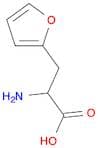
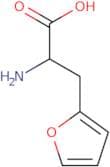
3-Furan-2-ylalanine, also known by its CAS number 4066-39-1, is an amino acid derivative characterized by the presence of a furan ring attached to the α-carbon of the alanine structure. This compound features a furan moiety, which is a five-membered aromatic ring containing oxygen, contributing to its unique chemical properties. The presence of the furan ring can influence the compound's reactivity and interactions, making it of interest in various biochemical and pharmaceutical applications. As an amino acid, 3-furan-2-ylalanine contains both an amino group (-NH2) and a carboxylic acid group (-COOH), allowing it to participate in peptide bond formation and protein synthesis. Its structural characteristics may also impart specific biological activities, potentially making it a candidate for research in drug development or as a biochemical probe. Overall, 3-furan-2-ylalanine exemplifies the intersection of organic chemistry and biochemistry, showcasing how modifications to amino acids can lead to novel compounds with diverse functionalities.
Formula:C7H9NO3
InChI:InChI=1/C7H9NO3/c8-6(7(9)10)4-5-2-1-3-11-5/h1-3,6H,4,8H2,(H,9,10)
SMILES:c1cc(CC(C(=O)O)N)oc1
Synonyms:- 3-(2-Furyl)-DL-alanine
- 2-Furanalanine
- 2-Furanpropanoicacid,a-amino-
- alpha-Amino-2-furanpropanoic acid
- DL-alpha-Amino-2-furanpropionic acid
- 3-furan-2-ylalanine
- 2-Amino-3-(furan-2-yl)propanoic acid
- 3-(2-Furyl)alanine
- DL-2-Furylalanine USP/EP/BP
- 3-(2-furyl)alanine(SALTDATA: FREE)
Sort by
Purity (%)
0
100
|
0
|
50
|
90
|
95
|
100
Found 3 products.
3-(2-furyl)alanine
CAS:Formula:C7H9NO3Purity:97%Color and Shape:Solid, Beige powderMolecular weight:155.1533-(2-Furyl)-DL-alanine
CAS:3-(2-Furyl)-DL-alanine is a chiral amino acid that is used as a building block in the synthesis of peptides and proteins. The enantiomers of 3-(2-furyl)alanine have been shown to have different properties. One enantiomer has been shown to be more soluble in cyclohexane and 2-propanol, while the other has been shown to be more soluble in water. This difference can be optimized by using an appropriate solvent or by adding a complexing agent such as sodium chloride. It also has been found that one enantiomer is more reactive than the other with metal ions such as copper(II).
Formula:C7H9NO3Purity:Min. 95%Molecular weight:155.15 g/mol