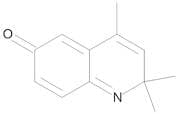
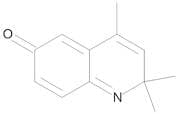
CAS 4071-18-5
:2,2,4-trimethylquinolin-6(2H)-one
Description:
2,2,4-Trimethylquinolin-6(2H)-one, with the CAS number 4071-18-5, is an organic compound belonging to the quinoline family, characterized by a fused bicyclic structure that includes a benzene ring and a pyridine ring. This compound features three methyl groups at the 2, 2, and 4 positions of the quinoline structure, contributing to its unique properties. It is typically a yellow to brown solid at room temperature and is soluble in organic solvents. The presence of the carbonyl group at the 6-position enhances its reactivity, making it useful in various chemical reactions, including those involving nucleophiles. 2,2,4-Trimethylquinolin-6(2H)-one is of interest in the fields of organic synthesis and materials science, often serving as a precursor or intermediate in the synthesis of more complex molecules. Additionally, it may exhibit biological activity, which warrants further investigation for potential applications in pharmaceuticals or agrochemicals. Safety data should be consulted for handling and storage, as with all chemical substances.
Formula:C12H13NO
InChI:InChI=1/C12H13NO/c1-8-7-12(2,3)13-11-5-4-9(14)6-10(8)11/h4-7H,1-3H3
SMILES:CC1=CC(C)(C)N=C2C=CC(=O)C=C12
Synonyms:- 2,2,4-Trimethyl-6(2H)-quinolone
- 6(2H)-Quinolone, 2,2,4-trimethyl-
Sort by
The purity filter is not visible because current products do not have associated purity data for filtering.
Found 2 products.
2,6-Dihydro-2,2,4-trimethyl-6-quinolone
CAS:Stability Light Sensitive
Applications A metabolite of Ethoxyquin. An oxidation product of the antidegradant Ethoxyquin found in the muscle of Atlantic salmon.
References Kahl, R., et al.: Toxicology, 28, 229 (1983), Burka, L., et al.: Xenobiotica, 26, 597 (1996), Bammler, T., et al.: Toxicol. Sci., 54, 30 (2000), Hayes, J., et al.: Cancer, 174, 103 (2001),Formula:C12H13NOColor and Shape:Dark Yellow SolidMolecular weight:187.24