CAS 40817-33-2
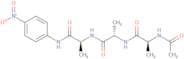
:Ac-Ala-Ala-Ala-pNA
Description:
Ac-Ala-Ala-Ala-pNA, also known as Acetyl-Ala-Ala-Ala-p-nitroanilide, is a synthetic peptide substrate commonly used in biochemical research, particularly in studies involving proteolytic enzymes. This compound consists of a sequence of three alanine (Ala) amino acids, which are linked together and acetylated at the N-terminus, enhancing its stability and solubility. The p-nitroanilide (pNA) moiety at the C-terminus serves as a chromogenic group, allowing for the quantification of enzymatic activity through colorimetric assays. When cleaved by specific proteases, the release of pNA results in a measurable color change, facilitating the study of enzyme kinetics and inhibition. Ac-Ala-Ala-Ala-pNA is typically used in laboratory settings and is valued for its specificity and sensitivity in detecting protease activity. Its characteristics make it a useful tool in various applications, including drug discovery and the investigation of protein interactions. As with all chemical substances, proper handling and safety protocols should be observed when working with Ac-Ala-Ala-Ala-pNA.
Formula:C17H23N5O6
Sort by
Purity (%)
0
100
|
0
|
50
|
90
|
95
|
100
Found 1 products.
Ac-Ala-Ala-Ala-pNA
CAS:Ac-Ala-Ala-Ala-pNA is a synthetic peptide that is derived from the natural amino acid sequence of cholecystokinin. It has been shown to have high affinity for phospholipid bilayers, which are lipid membranes that form the boundaries of cells and organelles. Ac-Ala-Ala-Ala-pNA can be used as a substrate molecule to study membrane permeability and selectivity in bioreactors. Ac-Ala-Ala-Ala-pNA also acts as a modulator of liposomal membranes, increasing the permeability of these membranes in order to allow more substrate molecules to pass through them.
Formula:C17H23N5O6Purity:Min. 95%Color and Shape:PowderMolecular weight:393.39 g/mol