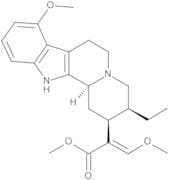
CAS 4098-40-2
:(-)-Mitragynine
- (-)-Mitragynine
- (16E,20b)-16,17-Didehydro-9,17-dimethoxycorynan-16-carboxylic Acid Methyl Ester
- 4098-40-2
- 9-Methoxycorynantheidine
- Corynan-16-carboxylic acid, 16,17-didehydro-9,17-dimethoxy-, methyl ester, (16E,20.beta.)-
- Corynan-16-carboxylic acid, 16,17-didehydro-9,17-dimethoxy-, methyl ester, (16E,20β)-
- Corynantheidine, 9-methoxy-
- Indolo[2,3-a]quinolizine-2-acetic acid, 3-ethyl-1,2,3,4,6,7,12,12b-octahydro-8-methoxy-α-(methoxymethylene)-, methyl ester, (αE,2S,3S,12bS)-
- Indolo[2,3-a]quinolizine-2-acetic acid, 3-ethyl-1,2,3,4,6,7,12,12b-octahydro-8-methoxy-α-(methoxymethylene)-, methyl ester, [2S-[2α(E),3α,12bβ]]-
- Methyl (16E,20beta)-9,17-dimethoxycoryn-16-en-16-carboxylate
- Methyl (16E,20beta)-9-methoxy-16-(methoxymethylene)corynan-17-oate
- Mitragynin
- See more synonyms
Mitragynine 100 µg/mL in Methanol
CAS:Controlled ProductFormula:C23H30N2O4Color and Shape:Single SolutionMolecular weight:398.50Mitragynine
CAS:Applications Mitragynine is a neurochemical, having both stimulant and opiate-like effects depending on the dosage. Currently, Mitragynine is being investigated for its ability to treat hard drug addiction.
References Kikura-Hanajiri, R., et al.: For. Toxicol., 27, 67 (2009); Bjoernstad, K., et al.: Clin. Toxicol., 47, 566 (2009); Parthasarathy, S., et al.: Anal. Bioanal. Chem., 397, 2023 (2010);Formula:C23H30N2O4Color and Shape:NeatMolecular weight:398.50Mitragynine (100 ug/mL in Methanol)
CAS:Formula:C23H30N2O4Color and Shape:Single SolutionMolecular weight:398.50Mitragynine - 95%
CAS:Controlled ProductAn indole alkaloid from tropical plant Mitragyna speciosa with psychostimulatory and opioid-like effects. It agonizes μ- and δ-opioid receptors and has anti-nociceptive properties. At low doses, the compound is stimulant but at high doses, it exerts sedative effects. It has been shown to induce conditioned place preference (CPP) in mice, indicating its role in reward and motivation pathways. Moreover, it has addiction potential with cognitive impairments.Formula:C23H30N2O4Purity:Min. 95 Area-%Color and Shape:PowderMolecular weight:398.5 g/molMitragynine - 97%
CAS:Controlled ProductAn indole alkaloid from tropical plant Mitragyna speciosa with psychostimulatory and opioid-like effects. It agonizes μ- and δ-opioid receptors and has anti-nociceptive properties. At low doses, the compound is stimulant but at high doses, it exerts sedative effects. It has been shown to induce conditioned place preference (CPP) in mice, indicating its role in reward and motivation pathways. Moreover, it has addiction potential with cognitive impairments.
Formula:C23H30N2O4Purity:Min. 97 Area-%Color and Shape:PowderMolecular weight:398.5 g/mol