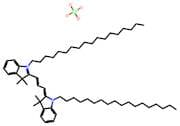
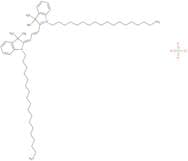
CAS 41085-99-8
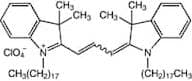
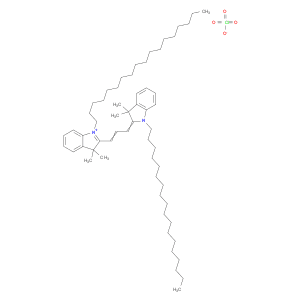
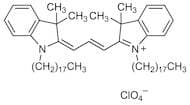
:1,1′-Dioctadecyl-3,3,3′,3′-tetramethylindocarbocyanine perchlorate
Description:
1,1′-Dioctadecyl-3,3,3′,3′-tetramethylindocarbocyanine perchlorate, commonly referred to as DiI, is a lipophilic fluorescent dye widely used in biological and biochemical research. This compound is characterized by its long hydrophobic octadecyl chains, which enhance its membrane permeability and allow for effective incorporation into lipid membranes. DiI exhibits strong fluorescence properties, particularly in the red region of the spectrum, making it suitable for various imaging applications, including cell tracking and membrane labeling. The perchlorate salt form contributes to its solubility in organic solvents, while the indocarbocyanine structure provides stability and resistance to photobleaching. Due to its lipophilic nature, DiI is often used to stain live cells and tissues, enabling researchers to visualize cellular processes and membrane dynamics. However, caution is advised when handling this compound, as it may pose environmental and health risks, necessitating appropriate safety measures during use.
Formula:C59H97ClN2O4
InChI:InChI=1/C59H97N2.ClHO4/c1-7-9-11-13-15-17-19-21-23-25-27-29-31-33-35-41-50-60-54-46-39-37-44-52(54)58(3,4)56(60)48-43-49-57-59(5,6)53-45-38-40-47-55(53)61(57)51-42-36-34-32-30-28-26-24-22-20-18-16-14-12-10-8-2;2-1(3,4)5/h37-40,43-49H,7-36,41-42,50-51H2,1-6H3;(H,2,3,4,5)/q+1;/p-1
InChI key:InChIKey=JVXZRNYCRFIEGV-UHFFFAOYSA-M
SMILES:C(CCCCCCCCCCCCCCCCC)N1C=2C(C(C)(C)C1=CC=CC3=[N+](CCCCCCCCCCCCCCCCCC)C=4C(C3(C)C)=CC=CC4)=CC=CC2.Cl(=O)(=O)(=O)[O-]
Synonyms:- (2Z)-2-[(E)-3-(3,3-Dimethyl-1-octadecylindol-1-ium-2-yl)prop-2-enylidene]-3,3-dimethyl-1-octadecylindole perchlorate
- 1,1-Dioctadecyl-3,3,3,3-tetramethylindocarbocyanine perchlorate
- 18:0-DiI
- 2-[(1E,3E)-3-(3,3-Dimethyl-1-octadecyl-1,3-dihydro-2H-indol-2-ylidene)-1-propen-1-yl]-3,3-dimethyl-1-octadecyl-3H-indolium perchlorate
- 2-[(1E,3Z)-3-(3,3-dimethyl-1-octadecyl-1,3-dihydro-2H-indol-2-ylidene)prop-1-en-1-yl]-3,3-dimethyl-1-octadecyl-3H-indolium perchlorate
- 3H-Indolium, 2-[3-(1,3-dihydro-3,3-dimethyl-1-octadecyl-2H-indol-2-ylidene)-1-propen-1-yl]-3,3-dimethyl-1-octadecyl-, perchlorate (1:1)
- 3H-Indolium, 2-[3-(1,3-dihydro-3,3-dimethyl-1-octadecyl-2H-indol-2-ylidene)-1-propenyl]-3,3-dimethyl-1-octadecyl-, perchlorate
- D 282
- D 282 (dye)
- DiI (dye)
- DiIC18(3)
- DiIC<sub>18</sub>
- DiIC<sub>18</sub>(3)
- Promokine PK-CA 707-60010
- Vybrant DiI
- DiIC18(3) [1,1'-Dioctadecyl-3,3,3',3'-tetraMethylindocarbocyanine perchlorate] *Crystalline*
- 2-[(E)-3-(3,3-DIMETHYL-1-OCTADECYL-1,3-DIHYDRO-2H-INDOL-2-YLIDENE)-1-PROPENYL]-3,3-DIMETHYL-1-OCTADECYL-3H-INDOLIUM PERCHLORATE
- 3h-indolium, 2-[3-(1,3-dihydro-3,3-dimethyl-
- 1,1'-DIOCTADECYL-3,3,3',3'-TETRAMETHYL-I
- 3,3,30,30-tetramethylindocarbocyanine Perchlorate
- 1,1'-Di-n-octadecyl-3,3,3',3'-tetraMethylindocarbocyanine perchlorate, 97%
- dilC18(3) dye
- DIL
- DILC18(3)
- DII
- 1-octadecyl-2h-indol-2-ylidene)-1-propenyl]-
- 1,1'-dioctadecyltetramethylindocarbocyanine perchlorate
- 1,1'-Dioctadecyl-3,3,3',3'-tetramethylindocarbocyanin perchlorate
- DiI perchlorate
- 1,10-dioctadecyl-
- 1,1’-dioctadecyl-3,3,3’,3’-tetramethylindocarbocyanineperchlorate(’dii’
- DiI perchlorate [1,1-Dioctadecyl-3,3,3,3-tetramethylindocarbocyanine perchlorate] *CAS 41085-99-8*
- 3,3-dimethyl-1-octadecyl, Perchlorate
- 1,1'-DIOCTADECYL-3,3,3',3'-TETRAMETHYLINDOCARBOCYANINE PERCHLORATE
- See more synonyms
Sort by
Purity (%)
0
100
|
0
|
50
|
90
|
95
|
100
Found 10 products.
1,1'-Di-n-octadecyl-3,3,3',3'-tetramethylindocarbocyanine perchlorate, 97%
CAS:1,1'-Dioctadecyl-3,3,3',3'-tetramethylindocarbocyanine per chlorate is a lipophilic dye used to record membrane voltage for fluidity studies. This retrograde stain is useful in staining neurons because the stain is relatively nontoxic to cell bodies and the dye is retained in neurons. In addition, 1Formula:C59H98ClN2O4Purity:97%Molecular weight:934.891,1′-Dioctadecyl-3,3,3′,3′-tetramethylindocarbocyanine perchlorate
CAS:Formula:C59H97ClN2O4Purity:%Color and Shape:SolidMolecular weight:933.8655DiI
CAS:DiI (DiIC18(3)) is a lipophilic membrane dye commonly used as a long-term tracer for neurons and other cells (λex/em=549/565 nm). Cost-effective and quality-assured.Formula:C59H97ClN2O4Purity:99.19% - 99.95%Color and Shape:SolidMolecular weight:933.87DiI
CAS:Formula:C59H97ClN2O4Purity:>93.0%(HPLC)(qNMR)Color and Shape:Light yellow to Brown powder to crystalMolecular weight:933.891,1'-Dioctadecyl-3,3,3',3'-tetramethylindocarbocyanin perchlorate
CAS:1,1'-Dioctadecyl-3,3,3',3'-tetramethylindocarbocyanin perchlorate
Formula:C59H97N2·ClO4Purity:By hplc: 100% (Typical Value in Batch COA)Color and Shape: red solidMolecular weight:933.87g/mol1,1'-Dioctadecyl-3,3,3',3'-tetramethylindocarbocyanin perchlorate
CAS:The 1,1'-dioctadecyl-3,3,3',3'-tetramethylindocarbocyanin perchlorate (DiI) is a fluorescent dye that can be used to label cellular structures in the histochemical staining of tissue sections. When used for this purpose, DiI binds to cell membrane lipids. DiI can also be used for analytical methods such as viral life detection and in vitro assays. The fluorescent properties of DiI are attributed to its ability to form an acyl chain intermediate with fatty acids. This intermediate is then cleaved by the enzyme polymerase chain reaction (PCR) and detected using the titration calorimetry method. The use of DiI has been shown to increase sensitivity and specificity of PCR-based assays by labeling viral nucleic acid targets.Formula:C59H97ClN2O4Purity:Min. 95%Color and Shape:PowderMolecular weight:933.87 g/mol1,1'-Dioctadecyl-3,3,3',3'-tetramethylindocarbocyanin perchlorate
CAS:1,1'-Dioctadecyl-3,3,3',3'-tetramethylindocarbocyanin perchlorate is a high quality chemical that is used as a reagent in the laboratory. It is also a useful intermediate and building block in the production of fine chemicals. CAS No. 41085-99-8 can be used to synthesize speciality chemicals with diverse properties such as research chemicals and versatile building blocks. The compound reacts easily with other compounds to form new compounds. It has been used as a reaction component for organic synthesis reactions.Formula:C59H97ClN2O4Purity:Min. 97 Area-%Molecular weight:933.87 g/molRef: 3D-J-100126
1gTo inquire5gTo inquire10gTo inquire500mgTo inquire2500mgTo inquire-Unit-ggTo inquire
![DiI Solution [for Cell Membrane Staining]](/_next/image/?url=https%3A%2Fstatic.cymitquimica.com%2Fproducts%2F3B%2Fthumb%2FD6202.jpg&w=3840&q=75)