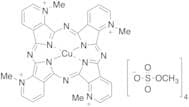
![Copper(4+), [1,8,15,22-tetramethyl-29H,31H-tetrapyrido[2,3-b:2′,3′-g:2′′,3′′-l:2′′′,3′′′-q]porphyr…](/_next/image/?url=https%3A%2Fstatic.cymitquimica.com%2Fcas-image%2Fthumb-webp%2F316460-copper-4-181522-tetramethyl-29h-31h-tetrapyrido-23-b-23-g-23-l-23-q-porphyraziniumato-2-kn29-kn30-kn31-kn32-sp-4-1-methyl-sulfate-1-4.webp&w=3840&q=75)
CAS 41276-95-3
:Copper(4+), [1,8,15,22-tetramethyl-29H,31H-tetrapyrido[2,3-b:2′,3′-g:2′′,3′′-l:2′′′,3′′′-q]porphyraziniumato(2-)-κN29,κN30,κN31,κN32]-, (SP-4-1)-, methyl sulfate (1:4)
Description:
Copper(4+), specifically in the context of the compound you mentioned, is a coordination complex featuring copper in a +4 oxidation state, which is relatively rare compared to its more common +1 and +2 oxidation states. This compound is characterized by its intricate structure, which includes a porphyrazine framework, a type of macrocyclic ligand known for its ability to coordinate with metal ions. The presence of multiple methyl groups in the ligand enhances its solubility and stability. The methyl sulfate component indicates that the compound is likely to be a salt, which can influence its solubility and reactivity in various solvents. The coordination of the copper ion with nitrogen atoms from the porphyrazine structure suggests potential applications in catalysis or as a dye, given the electronic properties imparted by the metal-ligand interactions. Overall, this compound exemplifies the complexity and versatility of metal-organic frameworks in coordination chemistry.
Formula:C32H24CuN12·4CH3O4S
InChI:InChI=1S/C32H24N12.CH4O4S.Cu/c1-41-13-5-9-17-21(41)29-33-25(17)38-30-23-19(11-7-15-43(23)3)27(35-30)40-32-24-20(12-8-16-44(24)4)28(36-32)39-31-22-18(26(34-31)37-29)10-6-14-42(22)2;1-5-6(2,3)4;/h5-16H,1-4H3;1H3,(H,2,3,4);/q+2;;+2/p-1
InChI key:InChIKey=OHJXJJRFAPKPSP-UHFFFAOYSA-M
SMILES:C[N+]1=C2C=3[N-]4[Cu+2]56[N-]7C(=C8C(=C7N=C9[N]5=C(N3)C=%10C9=[N+](C)C=CC%10)C=CC=[N+]8C)N=C%11[N]6=C(N=C4C2=CC=C1)C=%12C%11=CC=C[N+]%12C.S(OC)(=O)(=O)[O-]
Synonyms:- Copper(4+), [1,8,15,22-tetramethyl-29H,31H-tetrapyrido[2,3-b:2′,3′-g:2′′,3′′-l:2′′′,3′′′-q]porphyraziniumato(2-)-κN29,κN30,κN31,κN32]-, (SP-4-1)-, tetrakis(methyl sulfate)
- Copper(4+), [1,8,15,22-tetramethyl-29H,31H-tetrapyrido[2,3-b:2′,3′-g:2′′,3′′-l:2′′′,3′′′-q]porphyraziniumato(2-)-N29,N30,N31,N32]-, (SP-4-1)-, tetrakis(methyl sulfate)
- 29H,31H-Tetrapyrido[2,3-b:2′,3′-g:2′′,3′′-l:2′′′,3′′′-q]porphyrazinium, 1,8,15,22-tetramethyl-, copper complex
- 29H,31H-Tetrapyrido[2,3-b:2′,3′-g:2′′,3′′-l:2′′′,3′′′-q]porphyrazine, copper(4+) deriv.
- (1,8,15,22-Tetramethyl-29H,31H-tetrapyrido(2,3-b:2',3'-g:2'',3''-l:2''',3'''-q)porphyraziniumato(2-)-N29,N30,N31,N32)copper(4+) tetramethyl tetrakis(sulphate)
- Copper(4+), [1,8,15,22-tetramethyl-29H,31H-tetrapyrido[2,3-b:2′,3′-g:2′′,3′′-l:2′′′,3′′′-q]porphyraziniumato(2-)-κN29,κN30,κN31,κN32]-, (SP-4-1)-, methyl sulfate (1:4)
Sort by
Purity (%)
0
100
|
0
|
50
|
90
|
95
|
100
Found 3 products.
Cuprolinic Blue (>90%)
CAS:Controlled ProductApplications Cuprolinic Blue, has been shown to be able to form a particularly stable blue chromophore with single-stranded RNA in neuronal Nissl substance and nucleoli, and thus can be used for counterstaining of enteric neurons for peroxidase immunocytochemistry
References Holst, M., et al.: J. Neurosci., Meth., 62, 121 (1995);Formula:C32H26N12·4CH3O4S·CuPurity:>90%Color and Shape:NeatMolecular weight:1086.56Cuprolinic Blue-d12
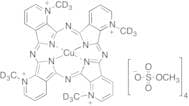
CAS:Controlled ProductApplications Cuprolinic Blue-d12 is the labeled analogue of Cuprolinic Blue (C834800), which has been shown to be able to form a particularly stable blue chromophore with single-stranded RNA in neuronal Nissl substance and nucleoli, and thus can be used for counterstaining of enteric neurons for peroxidase immunocytochemistry.
References Holst, M., et al.: J. Neurosci., Meth., 62, 121 (1995)Formula:C35H12D12CuN12•4(CD3O4S)Color and Shape:Dark BlueMolecular weight:1108.69Cuprolinic blue
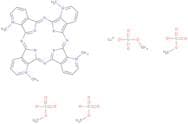
CAS:Cuprolinic blue is a fluorescent dye that is used for collagen gel localization and histochemical staining. It binds to the amide groups of proteins, such as collagen, and stains them blue. Cuprolinic blue has been used to show the ultrastructural localisation of collagen in blood capillaries in vivo. Cuprolinic blue also binds to nuclear DNA and can be used as a marker for the localization of nuclei in cells. This dye can also be used as an indicator for cervical cancer and proteoglycans in proteoglycan-enriched tissues.Formula:C36H36CuN12O16S4Purity:90%MinColor and Shape:PowderMolecular weight:1,084.6 g/mol