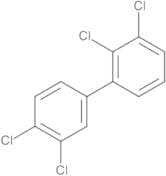
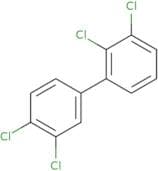
CAS 41464-43-1
:2,3,3′,4′-Tetrachlorobiphenyl
Description:
2,3,3′,4′-Tetrachlorobiphenyl, with the CAS number 41464-43-1, is a member of the polychlorinated biphenyl (PCB) family, which are synthetic organic chemicals known for their environmental persistence and potential toxicity. This compound consists of two phenyl rings connected by a single bond, with four chlorine atoms substituted at specific positions on the biphenyl structure. Its physical properties include a high melting point and low solubility in water, making it more soluble in organic solvents. 2,3,3′,4′-Tetrachlorobiphenyl is characterized by its hydrophobic nature, which contributes to its bioaccumulation in living organisms and its long half-life in the environment. Due to its chemical stability, it has been used in various industrial applications, including electrical equipment and heat transfer fluids. However, PCBs are now recognized as environmental pollutants, and their production has been banned or severely restricted in many countries due to concerns about their carcinogenicity and adverse effects on human health and ecosystems.
Formula:C12H6Cl4
InChI:InChI=1/C12H6Cl4/c13-9-5-4-7(6-11(9)15)8-2-1-3-10(14)12(8)16/h1-6H
InChI key:InChIKey=UNCGJRRROFURDV-UHFFFAOYSA-N
SMILES:ClC1=C(C=CC=C1Cl)C2=CC(Cl)=C(Cl)C=C2
Synonyms:- 1,1'-Biphenyl, 2,3,3',4'-Tetrachloro-
- 1,1′-Biphenyl, 2,3,3′,4′-tetrachloro-
- 2,3,3',4'-Pcb
- 2,3,3',4'-Tetrachloro-1,1'-biphenyl
- 2,3,3′,4′-Tetrachloro-1,1′-biphenyl
- 2,3,3′,4′-Tetrachlorobiphenyl
- 3,4,2′,3′-Tetrachlorobiphenyl
- 41464-43-1
- Pcb 56
- 2,3,3’,4’-tetrachlorobiphenyl(BZ#56)Solution,100mg/L,1ml
- 2,3,4',4'-Tetachlorobiphenyl
- 1,2-dichloro-3-(3,4-dichlorophenyl)benzene
- PCB NO 56
- 2,3,3',4'-TETRACHLOROBIPHENYL
- See more synonyms
Sort by
Purity (%)
0
100
|
0
|
50
|
90
|
95
|
100
Found 2 products.
2,3,3',4'-Tetrachlorobiphenyl
CAS:Controlled Product2,3,3',4'-Tetrachlorobiphenyl is an inhibitor that has been shown to induce apoptosis in human and Chinese hamster cancer cells. It inhibits the activity of kinases, which are enzymes that play a critical role in regulating cell growth and division. The inhibition of these enzymes leads to the activation of apoptotic pathways, resulting in cell death. Additionally, 2,3,3',4'-Tetrachlorobiphenyl has been found to inhibit the uptake of d-xylose by cells and decrease protein synthesis. This compound has potential medicinal applications for the treatment of tumors and cancers. It can be detected in urine samples and is considered a marker for exposure to environmental pollutants.Formula:C12H6Cl4Purity:Min. 95%Molecular weight:292 g/mol