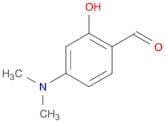
CAS 41602-56-6
:4-(Dimethylamino)Salicylaldehyde
Description:
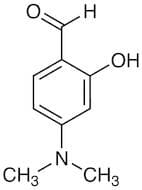
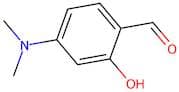
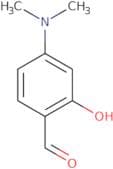
4-(Dimethylamino)salicylaldehyde, with the CAS number 41602-56-6, is an organic compound characterized by its aromatic structure, which includes a salicylaldehyde moiety substituted with a dimethylamino group. This compound typically appears as a yellow to orange crystalline solid and is known for its strong absorption in the ultraviolet-visible spectrum, making it useful in various analytical applications. It exhibits properties such as solubility in organic solvents like ethanol and acetone, while being less soluble in water due to its hydrophobic characteristics. The presence of the dimethylamino group imparts basic properties, allowing it to participate in various chemical reactions, including condensation and electrophilic substitution. Additionally, 4-(Dimethylamino)salicylaldehyde is often utilized in the synthesis of dyes, pharmaceuticals, and as a reagent in organic synthesis, particularly in the development of fluorescent probes and sensors. Its reactivity and functional groups make it a valuable compound in both research and industrial applications.
Formula:C9H11NO2
InChI:InChI=1/C9H11NO2/c1-10(2)8-4-3-7(6-11)9(12)5-8/h3-6,12H,1-2H3
SMILES:CN(C)c1ccc(C=O)c(c1)O
Synonyms:- 4-(Dimethylamino)-2-Hydroxybenzaldehyde
Sort by
Purity (%)
0
100
|
0
|
50
|
90
|
95
|
100
Found 5 products.
4-(Dimethylamino)salicylaldehyde
CAS:Formula:C9H11NO2Purity:98%Color and Shape:SolidMolecular weight:165.18914-(Dimethylamino)-2-hydroxybenzaldehyde
CAS:Formula:C9H11NO2Purity:>98.0%(GC)(T)Color and Shape:White to Light yellow to Light orange powder to crystalMolecular weight:165.194-Dimethylamino-2-hydroxybenzaldehyde
CAS:4-Dimethylamino-2-hydroxybenzaldehydeFormula:C9H11NO2Purity:98%Color and Shape: brown solidMolecular weight:165.19g/mol4-(Dimethylamino)-2-hydroxybenzaldehyde
CAS:Formula:C9H11NO2Purity:98%Color and Shape:SolidMolecular weight:165.1924-(Dimethylamino)-2-hydroxybenzaldehyde
CAS:4-(Dimethylamino)-2-hydroxybenzaldehyde (DMAA) is an anticancer agent that has been shown to enhance the antitumor effect of sodium succinate. DMAA binds to the tetradentate site of the DNA and prevents it from binding with a transcription factor, which may lead to cancer cell death. DMAA has low detection in urine and blood, making it difficult to detect its presence in patients. DMAA also has no known complexation partners, making it difficult for the body to excrete this drug. DMAA is not carcinogenic or mutagenic. It is used as a fluorescent probe for detecting hydroxy groups in organic compounds and as an environmental pollutant when mixed with other chemicals such as benzene and methylene chloride.Purity:Min. 95%