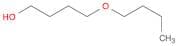
CAS 4161-24-4
:4-butoxybutan-1-ol
Description:
4-Butoxybutan-1-ol, with the CAS number 4161-24-4, is an organic compound classified as a butanol derivative. It features a butoxy group attached to a butan-1-ol backbone, making it a member of the alcohol functional group. This compound is typically a colorless to pale yellow liquid with a characteristic odor. It is soluble in water and organic solvents, which enhances its utility in various applications, including as a solvent and in chemical synthesis. The presence of both hydrophobic (butoxy) and hydrophilic (alcohol) components in its structure contributes to its amphiphilic nature, allowing it to interact with both polar and nonpolar substances. 4-Butoxybutan-1-ol is used in formulations for coatings, adhesives, and cleaning products due to its ability to improve the properties of these materials. Safety data indicates that, like many alcohols, it should be handled with care, as it may cause irritation upon contact with skin or eyes and should be used in well-ventilated areas to avoid inhalation of vapors.
Formula:C8H18O2
InChI:InChI=1/C8H18O2/c1-2-3-7-10-8-5-4-6-9/h9H,2-8H2,1H3
SMILES:CCCCOCCCCO
Synonyms:- 1-Butanol, 4-Butoxy-
Sort by
Purity (%)
0
100
|
0
|
50
|
90
|
95
|
100
Found 5 products.
4-Butoxy-1-butanol
CAS:Controlled Product4-Butoxy-1-butanol is a solvent that has been shown to be safe for use in humans. It is used to modify the chemical structure of d-glycero-d-galacto-heptose and can be used as a solvent. 4-Butoxy-1-butanol was found to be safe for primary cells and was able to normalize their metabolism and growth rate. This compound has also been shown to have diagnostic properties based on its ability to inhibit the production of camaldulensis leaves, which are known to produce naphthalene. The mechanism by which this compound inhibits camaldulensis leaf production is unknown, but it may involve an acceptor molecule or biochemical reactions.Formula:C8H18O2Purity:Min. 95%Color and Shape:Clear LiquidMolecular weight:146.23 g/mol4-Butoxybutanol
CAS:Controlled ProductApplications 4-Butoxybutanol is used in the synthesis of biomedical polyurethane for application as scaffold materials.
References Liu, H. et al.: J. App. Polym. Sci., 117, 235 (2010);Formula:C8H18O2Color and Shape:NeatMolecular weight:146.23