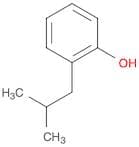
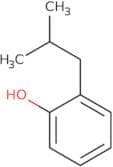
CAS 4167-75-3
:2-(2-Methylpropyl)phenol
Description:
2-(2-Methylpropyl)phenol, also known as 2-sec-butylphenol, is an organic compound characterized by a phenolic structure with a sec-butyl group attached to the second carbon of the aromatic ring. This compound typically appears as a colorless to pale yellow liquid with a distinct odor. It is slightly soluble in water but more soluble in organic solvents, reflecting its hydrophobic nature due to the bulky alkyl group. The presence of the hydroxyl (-OH) group imparts some polar characteristics, allowing for hydrogen bonding. 2-(2-Methylpropyl)phenol is primarily used in the synthesis of various chemical intermediates and may also serve as an antioxidant in certain applications. Its chemical properties include moderate volatility and reactivity, particularly in electrophilic aromatic substitution reactions. Safety data indicates that it should be handled with care, as it may cause skin and eye irritation. Overall, this compound is of interest in both industrial applications and research settings due to its unique structural features and functional properties.
Formula:C10H14O
InChI:InChI=1S/C10H14O/c1-8(2)7-9-5-3-4-6-10(9)11/h3-6,8,11H,7H2,1-2H3
InChI key:InChIKey=NFIDBGJMFKNGGQ-UHFFFAOYSA-N
SMILES:C(C(C)C)C1=C(O)C=CC=C1
Synonyms:- o-Isobutylphenol
- Phenol, o-isobutyl-
- 2-(2-Methylpropyl)phenol
- Phenol, 2-(2-methylpropyl)-
- 2-Isobutylphenol
Sort by
Purity (%)
0
100
|
0
|
50
|
90
|
95
|
100
Found 2 products.
2-(2-Methylpropyl)phenol
CAS:2-(2-Methylpropyl)phenol is a hydroxylated aromatic compound. It is used as a solvent in the production of hydroxybenzoic acid, which is an intermediate in the synthesis of biofuels. 2-(2-Methylpropyl)phenol has been shown to be an effective water treatment agent at low concentrations. This chemical also has optical properties that can be exploited for liquid crystal compositions and in the development of new materials with improved optical properties. 2-(2-Methylpropyl)phenol contains two phenyl groups, which can undergo substitution reactions with chloride or hydrogen chloride. The resulting products are alicyclic compounds.Formula:C10H14OPurity:Min. 95%Molecular weight:150.22 g/mol