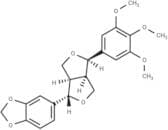
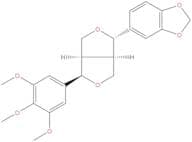
![5-[(4R)-4-(3,4,5-trimethoxyphenyl)tetrahydro-1H,3H-furo[3,4-c]furan-1-yl]-1,3-benzodioxole](/_next/image/?url=https%3A%2Fstatic.cymitquimica.com%2Fcas-image%2Fthumb-webp%2F327781-5-4r-4-345-trimethoxyphenyl-tetrahydro-1h-3h-furo-34-c-furan-1-yl-13-benzodioxole.webp&w=3840&q=75)
CAS 41689-50-3
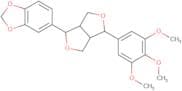
:5-[(4R)-4-(3,4,5-trimethoxyphenyl)tetrahydro-1H,3H-furo[3,4-c]furan-1-yl]-1,3-benzodioxole
Description:
The chemical substance known as "5-[(4R)-4-(3,4,5-trimethoxyphenyl)tetrahydro-1H,3H-furo[3,4-c]furan-1-yl]-1,3-benzodioxole," with the CAS number 41689-50-3, is a complex organic compound characterized by its unique molecular structure, which includes multiple functional groups and a fused ring system. This compound features a benzodioxole moiety, which contributes to its aromatic properties, and a tetrahydrofurofuran structure that enhances its potential biological activity. The presence of three methoxy groups on the phenyl ring suggests that it may exhibit significant electron-donating properties, potentially influencing its reactivity and solubility. Such compounds are often studied for their pharmacological properties, including antioxidant and anti-inflammatory activities. The stereochemistry indicated by the (4R) designation suggests that the compound may exhibit specific spatial arrangements that could affect its interaction with biological targets. Overall, this substance is of interest in medicinal chemistry and may have applications in drug development or as a research tool in understanding complex biological systems.
Formula:C22H24O7
InChI:InChI=1/C22H24O7/c1-23-18-7-13(8-19(24-2)22(18)25-3)21-15-10-26-20(14(15)9-27-21)12-4-5-16-17(6-12)29-11-28-16/h4-8,14-15,20-21H,9-11H2,1-3H3/t14?,15?,20?,21-/m0/s1
SMILES:COc1cc(cc(c1OC)OC)[C@H]1C2COC(c3ccc4c(c3)OCO4)C2CO1
Sort by
Purity (%)
0
100
|
0
|
50
|
90
|
95
|
100
Found 4 products.
5-[(4r)-4-(3,4,5-trimethoxyphenyl)tetrahydro-1h,3h-furo[3,4-c]furan-1-yl]-1,3-benzodioxole
CAS:Formula:C22H24O7Purity:98.5%Molecular weight:400.4218Epiaschantin
CAS:(+)-Epiaschantin shows marginal cancer cell line inhibitory activities. It also has anti-platelet aggregation activity.Formula:C22H24O7Purity:98%Color and Shape:SolidMolecular weight:400.427Epiaschantin
CAS:Epiaschantin is a naturally occurring bioactive compound, specifically an alkaloid, which is derived from the plant family Rhamnaceae. Its mode of action involves modulating neurotransmitter pathways, particularly influencing receptors and enzymes associated with the central nervous system. This modulation of neurotransmitter systems has made epiaschantin of particular interest in neuropharmacology research, where it is studied for its potential effects on neurological disorders and conditions. Its applications extend to the exploration of mechanisms underlying cognitive function and neuroprotection. As such, Epiaschantin serves as a valuable tool in the elucidation of neuroactive pathways and the development of therapeutic strategies aimed at neurological health.Formula:C22H24O7Purity:Min. 95%Molecular weight:400.4 g/mol
![5-[(4r)-4-(3,4,5-trimethoxyphenyl)tetrahydro-1h,3h-furo[3,4-c]furan-1-yl]-1,3-benzodioxole](/_next/image/?url=https%3A%2Fstatic.cymitquimica.com%2Fproducts%2FIN%2Fthumb%2FDA0071DX.jpg&w=3840&q=75)