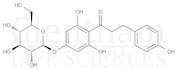
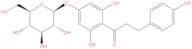
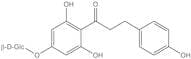
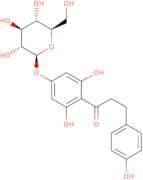
CAS 4192-90-9
:Trilobatin
Description:
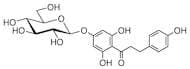
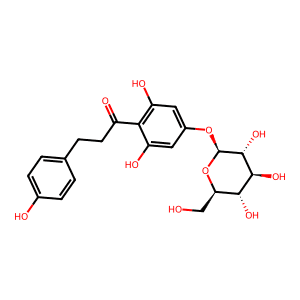
Trilobatin, with the CAS number 4192-90-9, is a chemical compound that belongs to the class of flavonoids, specifically a flavonol glycoside. It is primarily derived from various plant sources, particularly those in the family of legumes. Trilobatin is characterized by its glycosidic structure, which consists of a flavonoid aglycone linked to a sugar moiety. This compound exhibits a range of biological activities, including antioxidant properties, which contribute to its potential health benefits. Additionally, trilobatin has been studied for its anti-inflammatory and antimicrobial effects. Its solubility characteristics can vary depending on the solvent used, and it is generally more soluble in polar solvents due to the presence of the sugar component. As with many flavonoids, trilobatin may also play a role in plant pigmentation and UV protection. Further research is ongoing to fully elucidate its mechanisms of action and potential applications in pharmaceuticals and nutraceuticals.
Formula:C21H24O10
InChI:InChI=1/C21H24O10/c22-9-16-18(27)19(28)20(29)21(31-16)30-12-7-14(25)17(15(26)8-12)13(24)6-3-10-1-4-11(23)5-2-10/h1-2,4-5,7-8,16,18-23,25-29H,3,6,9H2/t16-,18-,19+,20-,21-/m1/s1
InChI key:InChIKey=GSTCPEBQYSOEHV-QNDFHXLGSA-N
SMILES:C(CCC1=CC=C(O)C=C1)(=O)C2=C(O)C=C(O[C@@H]3O[C@H](CO)[C@@H](O)[C@H](O)[C@H]3O)C=C2O
Synonyms:- 1-Propanone, 1-(4-(beta-D-glucopyranosyloxy)-2,6-dihydroxyphenyl)-3-(4-hydroxyphenyl)-
- 1-Propanone, 1-[4-(β-<span class="text-smallcaps">D</span>-glucopyranosyloxy)-2,6-dihydroxyphenyl]-3-(4-hydroxyphenyl)-
- 1-[4-(β-<span class="text-smallcaps">D</span>-Glucopyranosyloxy)-2,6-dihydroxyphenyl]-3-(4-hydroxyphenyl)-1-propanone
- Phloretin 4′-glucoside
- Phloretin 4′-β-<span class="text-smallcaps">D</span>-glucoside
- Phloretin-4′-O-β-<span class="text-smallcaps">D</span>-glucopyranoside
- Phloretine-4′-glucoside
- Prunin dihydrochalcone
- Trilobatin
- p-Phloridzin
- p-Phlorizin
- 1-[4-(β-D-Glucopyranosyloxy)-2,6-dihydroxyphenyl]-3-(4-hydroxyphenyl)-1-propanone
- 1-Propanone, 1-[4-(β-D-glucopyranosyloxy)-2,6-dihydroxyphenyl]-3-(4-hydroxyphenyl)-
- TRILOBATIN(SH)
- PRUNINDIHYDROCHALCONE
- 1-[2,6-dihydroxy-4-[(2S,3R,4S,5S,6R)-3,4,5-trihydroxy-6-(hydroxymethyl)oxan-2-yl]oxyphenyl]-3-(4-hydroxyphenyl)propan-1-one
- See more synonyms
Sort by
Purity (%)
0
100
|
0
|
50
|
90
|
95
|
100
Found 9 products.
Trilobatin
CAS:Formula:C21H24O10Purity:>95.0%(T)(HPLC)Color and Shape:White to Light yellow powder to crystalMolecular weight:436.41Trilobatin
CAS:Trilobatin analytical standard provided with w/w absolute assay, to be used for quantitative titration.Formula:C21H24O10Purity:(HPLC) ≥99%Color and Shape:PowderMolecular weight:436.42Trilobatin
CAS:Trilobatin has anti-oxidant, and anti-inflammatory effects, it can increase superoxide dismutase (SOD) activity, and it potentially inhibits the lipopolysaccharide (LPS)-induced inflammatory response by suppressing the NF-κB signaling pathway. Trilobatin shows a strong inhibitory activity against α-glucosidase and a moderate inhibitory activity against α-amylase for management of postprandial hyperglycemia with less side effect.Formula:C21H24O10Purity:95%~99%Color and Shape:PowderMolecular weight:436.413Trilobatin
CAS:Trilobatin (P-Phlorizin) has anti-oxidant effect, can increase superoxide dismutase (SOD) activity.Trilobatin has anti-inflammatory effect, it potentiallyFormula:C21H24O10Purity:97.16%Color and Shape:SolidMolecular weight:436.41Ref: TM-T2S0731
1mg50.00€5mg99.00€1mL*10mM (DMSO)109.00€10mg141.00€25mg260.00€50mg385.00€100mg557.00€200mg790.00€Trilobatin
CAS:Trilobatin is a high-purity steviol glycoside that is extracted from the leaves of the plant Stevia rebaudiana. It has been shown to have significant antioxidant properties, and its use as an anti-inflammatory agent has been shown in animal models. Trilobatin inhibits oxidative injury by binding to toll-like receptors on the surface of cells, preventing activation of certain enzymes and reducing inflammation. This activity may be due to inhibition of caspase-independent cell death or mitochondrial membrane potential. Trilobatin also acts as a pro-apoptotic protein by triggering the release of cytochrome C from mitochondria, which leads to apoptosis.Formula:C21H24O10Purity:Min. 95%Color and Shape:PowderMolecular weight:436.41 g/mol