CAS 4195-17-9
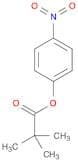
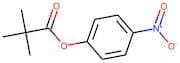
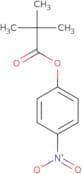
:4-Nitrophenyl 2,2-dimethylpropanoate
Description:
4-Nitrophenyl 2,2-dimethylpropanoate is an organic compound characterized by its ester functional group, which is formed from the reaction of 4-nitrophenol and 2,2-dimethylpropanoic acid. This compound typically appears as a yellow crystalline solid and is known for its aromatic properties due to the presence of the nitrophenyl group. It has a molecular formula that reflects its structure, incorporating both aromatic and aliphatic components. The nitro group (-NO2) on the phenyl ring contributes to its reactivity, making it a useful intermediate in organic synthesis, particularly in the production of pharmaceuticals and agrochemicals. Additionally, the bulky 2,2-dimethylpropanoate moiety can influence its solubility and steric properties, affecting its interactions in various chemical environments. As with many nitro compounds, it may exhibit specific safety and handling considerations due to potential toxicity and environmental impact. Proper precautions should be taken when working with this substance in laboratory settings.
Formula:C11H13NO4
InChI:InChI=1S/C11H13NO4/c1-11(2,3)10(13)16-9-6-4-8(5-7-9)12(14)15/h4-7H,1-3H3
InChI key:InChIKey=QADVJDGFQGNSIF-UHFFFAOYSA-N
SMILES:O(C(C(C)(C)C)=O)C1=CC=C(N(=O)=O)C=C1
Synonyms:- 4-Nitrophenyl 2,2-dimethylpropanoate
- Pivalic acid, p-nitrophenyl ester
- Propanoic acid, 2,2-dimethyl-, 4-nitrophenyl ester
- p-Nitrophenyl pivalate
- p-Nitrophenyl trimethylacetate
Sort by
Purity (%)
0
100
|
0
|
50
|
90
|
95
|
100
Found 3 products.
4-Nitrophenyl trimethylacetate
CAS:4-Nitrophenyl trimethylacetate is a cytosolic proteinase inhibitor. It binds to the active site of trypsin and other enzymes that hydrolyze peptide bonds, thereby inhibiting the activity of these enzymes. 4-Nitrophenyl trimethylacetate has been shown to inhibit soybean trypsin, which has led to its use as a model system for studying enzyme inhibition. The binding site on 4-Nitrophenyl trimethylacetate is competitive with respect to substrate binding but not with respect to the enzyme's catalytic triad. This inhibitor also has a high buffer capacity and can be used in low pH systems.
Purity:Min. 95%Molecular weight:223.23 g/mol