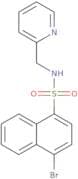
CAS 419538-69-5
:4-Bromo-N-(2-pyridinylmethyl)-1-naphthalenesulfonamide
Description:
4-Bromo-N-(2-pyridinylmethyl)-1-naphthalenesulfonamide is a chemical compound characterized by its complex structure, which includes a naphthalene ring, a sulfonamide group, and a bromine atom. This compound features a pyridine moiety that is substituted with a methyl group, contributing to its unique properties. It is typically a solid at room temperature and may exhibit moderate solubility in organic solvents, depending on the specific conditions. The presence of the sulfonamide functional group suggests potential applications in medicinal chemistry, particularly in the development of pharmaceuticals, as sulfonamides are known for their antibacterial properties. The bromine atom can also enhance the compound's reactivity and influence its biological activity. Additionally, the compound's molecular structure may allow for interactions with biological targets, making it of interest in drug discovery and development. Safety and handling precautions should be observed, as with any chemical substance, due to potential toxicity and environmental impact.
Formula:C16H13BrN2O2S
InChI:InChI=1S/C16H13BrN2O2S/c17-15-8-9-16(14-7-2-1-6-13(14)15)22(20,21)19-11-12-5-3-4-10-18-12/h1-10,19H,11H2
InChI key:InChIKey=GJSDYQXOSHKOGX-UHFFFAOYSA-N
SMILES:S(NCC1=CC=CC=N1)(=O)(=O)C=2C3=C(C(Br)=CC2)C=CC=C3
Synonyms:- Pyrabactin
- 4-Bromo-N-(2-pyridinylmethyl)-1-naphthalenesulfonamide
- 1-Naphthalenesulfonamide, 4-bromo-N-(2-pyridinylmethyl)-
Sort by
Purity (%)
0
100
|
0
|
50
|
90
|
95
|
100
Found 2 products.
4-Bromo-N-(pyridin-2-ylmethyl)naphthalene-1-sulfonamide
CAS:4-Bromo-N-(pyridin-2-ylmethyl)naphthalene-1-sulfonamidePurity:95%Molecular weight:377.26g/molPyrabactin
CAS:<p>Pyrabactin is a potent inhibitor of kinases, specifically cyclin-dependent kinase (CDK) and other protein kinases. It is an analog of the Chinese herbal medicine pyrabactin, which has been used for centuries to treat various ailments including cancer. Pyrabactin has been shown to induce apoptosis in cancer cells and inhibit tumor growth in animal models. Additionally, it has anticancer properties due to its ability to inhibit the activity of CDKs, which are essential for cell division and proliferation. Pyrabactin is excreted primarily through urine and has potential as a therapeutic agent for cancer treatment.</p>Formula:C16H13BrN2O2SPurity:Min. 95%Molecular weight:377.3 g/mol