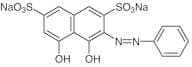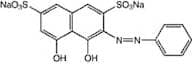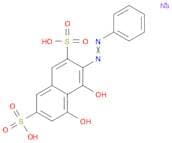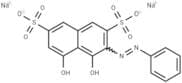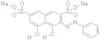
CAS 4197-07-3
:Chromotrope 2R
Description:
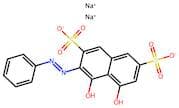
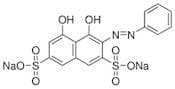
Chromotrope 2R, with the CAS number 4197-07-3, is a synthetic dye belonging to the azo dye class, characterized by its vibrant red color. It is primarily used in various applications, including textile dyeing, paper coloring, and as a biological stain in microscopy. The dye exhibits good solubility in water, which makes it suitable for aqueous applications. Chromotrope 2R is known for its stability under light and heat, although, like many azo dyes, it may undergo degradation under extreme conditions. Its chemical structure features azo (-N=N-) linkages, which are responsible for its color properties. While it is effective for its intended uses, safety considerations are important, as some azo dyes can release aromatic amines upon degradation, which may pose health risks. Therefore, handling Chromotrope 2R requires adherence to safety guidelines to minimize exposure. Overall, Chromotrope 2R is valued for its coloring properties in various industries, but awareness of its chemical behavior and safety profile is essential.
Formula:C16H12N2O8S2·2Na
InChI:InChI=1S/C16H12N2O8S2.2Na/c19-12-8-11(27(21,22)23)6-9-7-13(28(24,25)26)15(16(20)14(9)12)18-17-10-4-2-1-3-5-10;;/h1-8,19-20H,(H,21,22,23)(H,24,25,26);;
InChI key:InChIKey=HKJCYVHPXAKYEJ-UHFFFAOYSA-N
SMILES:OC=1C2=C(C=C(S(=O)(=O)O)C1N=NC3=CC=CC=C3)C=C(S(=O)(=O)O)C=C2O.[Na]
Synonyms:- 2,7-Naphthalenedisulfonic acid, 4,5-dihydroxy-3-(2-phenyldiazenyl)-, sodium salt (1:2)
- 2,7-Naphthalenedisulfonic acid, 4,5-dihydroxy-3-(phenylazo)-, disodium salt
- 4,5-Dihydroxy-3-phenylazo-2,7-naphthalenedisulfonic acid,disodium salt
- Acid Red 29
- Acilan Chromotrope RR
- Brasilan Fast Fuchsine G
- Chromotrop 2R
- Chromotrope 2 R
- Chromotrope 2 R (CI 16570)
- Chromotrope Red 2R
- Disodium 4,5-Dihydroxy-3-Phenylazonaphthalene-2,7-Disulphonate
- Disodium 4,5-dihydroxy-3-(phenylazo)naphthalene-2,7-disulfonate
- Fast Fuchsin G
- Fast Fuchsine G
- Hispacid Fuchsin G
- chromotrop 2 R for microscopy and complexometry
- disodium (3Z)-5-hydroxy-4-oxo-3-(phenylhydrazono)-3,4-dihydronaphthalene-2,7-disulfonate
- C.I. Acid Red 29
- Chromotrope 2R
- C.I. Acid Red 29, disodium salt (8CI)
- Chromotrope 2R
- C.I. Acid Red 29, disodium salt
- C.I. Acid Red 29 (7CI)
- chromotrope 2R (C.I. 16570)
- C.I. Acid Red 29
- Acid Red 29~C.I. 16570
- C.I. 16570
- See more synonyms
Sort by
Purity (%)
0
100
|
0
|
50
|
90
|
95
|
100
Found 8 products.
Chromotrope 2R
CAS:Formula:C16H10N2Na2O8S2Color and Shape:Amber to Brown powder to crystalMolecular weight:468.36Chromotrope 2R
CAS:Employed as an indicator for complexometry. It is also applied as a stain used in modified Gomori Trichrome stain. Used as a stain for cytology. This Thermo Scientific Chemicals brand product was originally part of the Alfa Aesar product portfolio. Some documentation and label information may referFormula:C16H10N2Na2O8S2Color and Shape:Crystals or powder or crystalline powder, Red to brownMolecular weight:468.36Chromotrope 2R
CAS:Chromotrope 2R functions as a chromogenic analytical probe for protein quantification, staining basic proteins red and exhibiting a peak wavelength shift fromFormula:C16H10N2Na2O8S2Color and Shape:SolidMolecular weight:468.37Chromotrope 2R (C.I. 16570)
CAS:Formula:C16H10N2Na2O8S2Color and Shape:Red to brown powderMolecular weight:468.37Chromotrope 2R
CAS:Chromotrope 2R is a chromogenic substrate that is used to assay protothecosis. Phase chromatography of this compound produces two different zones: one that is blue and another that is yellow-green. The blue zone indicates the presence of phosphotungstic acid, which can be used as a diagnostic marker for protothecosis. The yellow-green zone indicates the presence of keratinization, which can be used as a diagnostic marker for protothecosis. Chromotrope 2R has also been shown to inhibit keratinization in tissues, leading to a lack of staining and cellular changes in the surrounding tissue. Prototheca species are filamentous eukaryotic organisms that produce a variety of polyketides and other secondary metabolites. These compounds are toxic to animals when ingested and can lead to hemorrhagic necrosis in both humans and animals. Protothecosis is caused by infection with Prototheca zopfii or Prototheca wFormula:C16H10N2Na2O8S2Color and Shape:PowderMolecular weight:468.37 g/molChromotrope 2R
CAS:Formula:C16H10N2Na2O8S2Color and Shape:Brownish red, Crystalline powderMolecular weight:468.37