CAS 42061-89-2
:5-formylfuran-2-carbonitrile
Description:
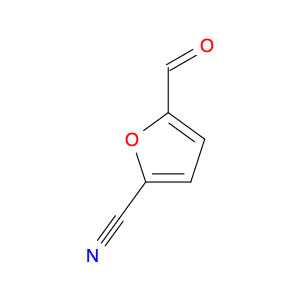
5-Formylfuran-2-carbonitrile is an organic compound characterized by its furan ring structure, which is a five-membered aromatic ring containing one oxygen atom. The compound features a formyl group (-CHO) at the 5-position and a cyano group (-CN) at the 2-position of the furan ring. This unique arrangement contributes to its reactivity and potential applications in organic synthesis and medicinal chemistry. The presence of both the aldehyde and nitrile functional groups allows for various chemical transformations, making it a versatile intermediate in the synthesis of more complex molecules. Additionally, 5-formylfuran-2-carbonitrile may exhibit interesting physical properties, such as solubility in polar solvents, and could participate in reactions like nucleophilic additions or cycloadditions. Its CAS number, 42061-89-2, is a unique identifier that facilitates the search for information regarding its properties, safety data, and applications in scientific literature. Overall, this compound is of interest for researchers exploring novel chemical pathways and materials.
Formula:C6H3NO2
InChI:InChI=1/C6H3NO2/c7-3-5-1-2-6(4-8)9-5/h1-2,4H
SMILES:c1cc(C=O)oc1C#N
Synonyms:- 2-Furancarbonitrile, 5-Formyl-
- 5-Formyl-2-furonitrile
Sort by
Purity (%)
0
100
|
0
|
50
|
90
|
95
|
100
Found 4 products.
5-Formylfuran-2-carbonitrile
CAS:Formula:C6H3NO2Purity:95%Color and Shape:SolidMolecular weight:121.0935Ref: 10-F641120
1g367.00€5g1,037.00€10g1,932.00€2.5g712.00€50mg72.00€100mg104.00€250mg156.00€500mg266.00€5-Cyano-2-furaldehyde
CAS:5-Cyano-2-furaldehyde is an antimicrobial compound that belongs to the class of amides. It has been shown to have strong antimicrobial activity against populations of bacteria and fungi. 5-Cyano-2-furaldehyde has been found to be effective in inhibiting microbial growth in a square ecosystem, which is a small experimental area with different types of vegetation. This compound is also active against dry weight microbes and can inhibit the growth of populations at chloride concentrations up to 100 mg/L. The expression of cyanomethylene synthase genes was observed in this experiment, suggesting that 5-cyano-2-furaldehyde may be involved in its synthesis. Regression analysis showed that hydrogen chloride was the most important variable affecting the population growth rate.Formula:C6H3NO2Purity:Min. 95%Molecular weight:121.09 g/mol