CAS 42135-76-2
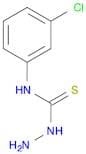
:4-(3-Chlorophenyl)-thiosemicarbazide
Description:
4-(3-Chlorophenyl)-thiosemicarbazide is an organic compound characterized by its thiosemicarbazide functional group, which features a sulfur atom bonded to a carbonyl and an amine. This compound typically appears as a solid and is known for its potential biological activity, including antimicrobial and anticancer properties. The presence of the 3-chlorophenyl group enhances its lipophilicity and may influence its interaction with biological targets. It is often synthesized through the reaction of thiosemicarbazide with appropriate chlorinated aromatic compounds. The compound's reactivity can be attributed to the presence of both the thiosemicarbazide moiety and the chlorophenyl substituent, which can participate in various chemical reactions, including nucleophilic substitutions and complexation with metal ions. Safety data indicates that, like many thiosemicarbazides, it should be handled with care due to potential toxicity. Overall, 4-(3-Chlorophenyl)-thiosemicarbazide serves as a valuable compound in medicinal chemistry and research applications.
Formula:C7H8ClN3S
InChI:InChI=1/C7H8ClN3S/c8-5-2-1-3-6(4-5)10-7(12)11-9/h1-4H,9H2,(H2,10,11,12)
SMILES:c1cc(cc(c1)N=C(NN)S)Cl
Synonyms:- 4-(3-Chlorophenyl)-3-thiosemicarbazide
- N-(3-chlorophenyl)hydrazinecarbothioamide
Sort by
Purity (%)
0
100
|
0
|
50
|
90
|
95
|
100
Found 4 products.
N-(3-Chlorophenyl)hydrazinecarbothioamide
CAS:Formula:C7H8ClN3SColor and Shape:SolidMolecular weight:201.67654-(3-Chlorophenyl)-3-thiosemicarbazide
CAS:4-(3-Chlorophenyl)-3-thiosemicarbazide
Molecular weight:201.67652g/mol4-(3-Chlorophenyl)-3-thiosemicarbazide
CAS:Formula:C7H8ClN3SColor and Shape:SolidMolecular weight:201.674-(3-Chlorophenyl)-3-thiosemicarbazide
CAS:4-(3-Chlorophenyl)-3-thiosemicarbazide is a hydrazone that has been shown to have antibacterial and anticancer activities. This compound binds to DNA, which leads to the inhibition of bacterial growth and cancer cell proliferation. 4-(3-Chlorophenyl)-3-thiosemicarbazide has been shown to inhibit the growth of P. aeruginosa in vitro by binding to the DNA gyrase and topoisomerase IV enzymes, preventing them from maintaining the integrity of bacterial DNA. Molecular modeling studies have shown that this compound binds preferentially to human astrocytes rather than cancer cells. It is also an anhydrous potassium carbonate salt that is soluble in water, alcohols, ethers, and acetones.Formula:C7H8ClN3SPurity:Min. 95%Molecular weight:201.68 g/mol