

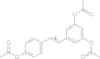
CAS 42206-94-0
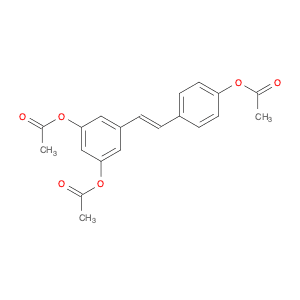
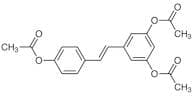
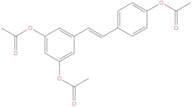
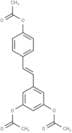
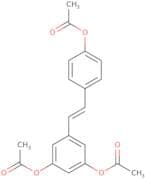
:Acetyl-trans-resveratrol
Description:
Acetyl-trans-resveratrol is a synthetic derivative of resveratrol, a naturally occurring polyphenolic compound found in various plants, particularly in grapes and berries. This compound is characterized by its acetyl group, which enhances its lipophilicity and potentially its bioavailability compared to its parent compound. Acetyl-trans-resveratrol exhibits antioxidant properties, which may contribute to its potential health benefits, including anti-inflammatory and cardioprotective effects. The compound is often studied for its role in promoting cellular health and longevity, as well as its potential in cancer prevention. It is soluble in organic solvents but has limited solubility in water, which is a common characteristic of many polyphenols. The compound's stability and efficacy can be influenced by factors such as pH and temperature. As research continues, acetyl-trans-resveratrol is being explored for its therapeutic applications, particularly in the fields of nutrition and pharmacology, highlighting its significance in the study of natural compounds and their derivatives.
Formula:C20H18O6
InChI:InChI=1/C20H18O6/c1-13(21)24-18-8-6-16(7-9-18)4-5-17-10-19(25-14(2)22)12-20(11-17)26-15(3)23/h4-12H,1-3H3/b5-4+
Synonyms:- AcetylResveratrol
- 3-(acetyloxy)-5-{(E)-2-[4-(acetyloxy)phenyl]ethenyl}phenyl acetate (non-preferred name)
- Acetyl Resveratrol
- Acetyl trans-resveratrol
- 3,4',5-Triacetoxy-trans-stilbene, trans-Triacetylresveratrol, trans-Resveratrol triacetate
- Acetyl-resveratrol, Acetyl Trans-resveratrol
- trans-Triacetylresveratrol, trans-Resveratrol triacetate, 4-[(E)-2-(3,5-Diacetoxphenyl)vinyl]phenyl acetate
- Resveratrol triacetate
- ACETYL TRANS-RESVERATROL 42206-94-0
- Resveratrol 3,5,4'-triacetate
- Resveratrol Triacetate Impurity
- 1,3-Benzenediol, 5-[(1E)-2-[4-(acetyloxy)phenyl]ethenyl]-, 1,3-diacetate
- Resveratrol, Triacetyl
- 3,5,4'-Tri-O-acetylresveratrol
- Acethyl Resveratrol
- 4-[(E)-2-(3,5-Diacetoxyphenyl)vinyl]phenyl acetate 98+%
- acetic acid [4-[(E)-2-(3,5-diacetyloxyphenyl)ethenyl]phenyl] ester
- Resveratrol, Triacetyl - CAS 42206-94-0 - Calbiochem
- 3,4',5-Triacetoxy-trans-stilbene
- Resveratrol Impurity 26 (trans-Resveratrol Triacetate)
- 3,4',5-Triacetoxy-trans-stilbene 98+%
- 4-[(E)-2-(3,5-Diacetoxyphenyl)vinyl]phenyl acetate
- trans-Resveratrol Triacetate
- See more synonyms
Sort by
Purity (%)
0
100
|
0
|
50
|
90
|
95
|
100
Found 12 products.
trans-Resveratrol Triacetate
CAS:Formula:C20H18O6Purity:97%Color and Shape:SolidMolecular weight:354.3533Triacetylresveratrol
CAS:Formula:C20H18O6Purity:>98.0%(GC)Color and Shape:White to Almost white powder to crystalMolecular weight:354.364-[(E)-2-(3,5-Diacetoxyphenyl)vinyl]phenyl acetate
CAS:4-[(E)-2-(3,5-Diacetoxyphenyl)vinyl]phenyl acetateFormula:C20H18O6Purity:98%Color and Shape: light yellow solidMolecular weight:354.35331g/molTriacetylresveratrol
CAS:Triacetylresveratrol (Acetyl-trans-resveratrol) has anti-cancer activity, it inhibits the phosphorylation of STAT3 and NFκB in pancreatic cancer cells.
Formula:C20H18O6Purity:99.81%Color and Shape:Off White PowderMolecular weight:354.35trans-Resveratrol Triacetate
CAS:Controlled ProductApplications trans-Resveratrol Triacetate is the acetylated analogue of Resveratrol (R150000) that is a natural antioxidant and a potential radioprotective agent. trans-Resveratrol Triacetate induces p53 activity and inhibits proliferation in breast and prostate tumor cell lines.
References Torres, P. et al.: J. Agric. Food Chem., 58, 807 (2010); Kotagiri, S. et al.: J. Chem. Pharmac. Sci., 3, 191 (2010); Koide, K. et al.: ACS Med. Chem. Chem. Lett., 2, 270 (2011);Formula:C20H18O6Color and Shape:NeatMolecular weight:354.35Resveratrol triacetate
CAS:Resveratrol is a natural phenol that has been shown to have anticancer and anti-inflammatory properties. Resveratrol triacetate is an acetylated form of resveratrol that has a greater stability than resveratrol and may be more bioavailable. Resveratrol triacetate has been shown to inhibit the proliferation of skin cells, muscle cells, and bronchial cells in vitro. Resveratrol triacetate also decreases the production of pro-inflammatory cytokines in macrophages, which are white blood cells involved in the inflammatory response. Resveratrol triacetate inhibits the expression of genes that lead to inflammation and cancer development by binding to nuclear receptors, which are proteins found on the surface of cells that bind specific molecules such as hormones or drugs.Formula:C20H18O6Purity:Min. 95%Color and Shape:PowderMolecular weight:354.35 g/mol




![4-[(E)-2-(3,5-Diacetoxyphenyl)vinyl]phenyl acetate](/_next/image/?url=https%3A%2Fstatic.cymitquimica.com%2Fproducts%2F54%2Fthumb%2FOR14747.jpg&w=3840&q=75)



![4-[(E)-2-(3,5-Diacetoxyphenyl)vinyl]phenyl acetate](/_next/image/?url=https%3A%2Fstatic.cymitquimica.com%2Fproducts%2F10%2Fthumb%2FF952029.jpg&w=3840&q=75)

