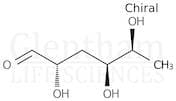
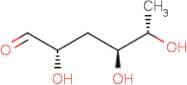
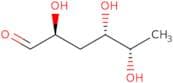
CAS 4221-05-0
:3,6-Dideoxy-L-xylo-hexose
Description:
3,6-Dideoxy-L-xylo-hexose is a monosaccharide characterized by its unique structure, which includes six carbon atoms and two hydroxyl groups, making it a member of the hexose family. This sugar is notable for the absence of hydroxyl groups at the 3 and 6 positions, which distinguishes it from other hexoses. It typically exists in a cyclic form, adopting a pyranose or furanose configuration, depending on the conditions. The stereochemistry of 3,6-Dideoxy-L-xylo-hexose is defined by its specific arrangement of hydroxyl groups, contributing to its biological activity and potential applications in glycoscience. This compound is often involved in the biosynthesis of various natural products and can serve as a building block in the synthesis of more complex carbohydrates. Its CAS number, 4221-05-0, is a unique identifier that facilitates its identification in chemical databases. As with many sugars, it is soluble in water and may participate in various chemical reactions, including glycosylation and oxidation, which are important in both synthetic and biological contexts.
Formula:C6H12O4
InChI:InChI=1/C6H14O4/c1-4(8)6(10)2-5(9)3-7/h4-10H,2-3H2,1H3/t4-,5-,6-/m0/s1
InChI key:InChIKey=GNTQICZXQYZQNE-ZLUOBGJFSA-N
SMILES:C([C@@H]([C@H](C)O)O)[C@@H](C=O)O
Synonyms:- Colitose
- L-Colitose
- L-xylo-Hexose, 3,6-dideoxy-
- 3,6-Dideoxy-L-xylo-hexose
- 3-Deoxy-L-fucose
- See more synonyms
Sort by
Purity (%)
0
100
|
0
|
50
|
90
|
95
|
100
Found 3 products.
Colitose
CAS:<p>Colitose is a sugar that has antimicrobial properties. It is a monosaccharide, which means it contains six carbon molecules. Colitose has been shown to inhibit bacterial growth and to prevent the development of resistant mutants in human serum. Colitose has also been shown to have therapeutic potential for infectious diseases such as bowel disease and other inflammatory bowel diseases. The structural analysis of colitose revealed that it contains terminal residues at the end of each chain, which are composed of glucose, galactose, and mannose. The glycan chains are linked together by alpha-1,6-glycosidic bonds. These terminal residues serve as a receptor for Toll-like receptors (TLRs), which are found on cells in the bowel wall and help regulate inflammation.</p>Formula:C6H12O4Purity:Min. 95%Color and Shape:PowderMolecular weight:148.16 g/mol