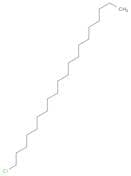
CAS 42217-02-7
:1-Chloroeicosane
Description:
1-Chloroeicosane is an organic compound classified as a chlorinated alkane, specifically a long-chain alkyl halide. It features a straight-chain structure with a total of 20 carbon atoms and one chlorine atom attached to the first carbon in the chain. This compound is typically a colorless to pale yellow liquid at room temperature, exhibiting low solubility in water due to its hydrophobic nature, while being soluble in organic solvents. The presence of the chlorine atom introduces polar characteristics, which can influence its reactivity and interactions with other substances. 1-Chloroeicosane is primarily used in research and industrial applications, including as a reagent in organic synthesis and as a potential intermediate in the production of various chemical compounds. Its physical properties, such as boiling point and density, are influenced by the length of the carbon chain and the presence of the chlorine atom. Safety precautions should be taken when handling this compound, as it may pose health risks if inhaled or ingested.
Formula:C20H41Cl
InChI:InChI=1S/C20H41Cl/c1-2-3-4-5-6-7-8-9-10-11-12-13-14-15-16-17-18-19-20-21/h2-20H2,1H3
InChI key:InChIKey=AFGNVSCTEXUEJE-UHFFFAOYSA-N
SMILES:C(CCCCCCCCCC)CCCCCCCCCCl
Synonyms:- 1-Chloroeicosane
- 1-Chloroicosane
- Eicosane, 1-chloro-
Sort by
Purity (%)
0
100
|
0
|
50
|
90
|
95
|
100
Found 4 products.
1-Chloroeicosane
CAS:1-Chloroeicosane is a hydrochloric acid solute that can be used as an organic solvent in the synthesis of 1-chloro-2,3-epoxypropane. The chloride ion acts as a solute, and the hydroxyl group and hydroxy group act as solutes. The chemical composition of 1-chloroeicosane is C9H14ClO. It has a molecular weight of 186.24 g/mol. The boiling point is 198 oC and its melting point is -21 oC. This compound has been detected in wastewater at concentrations of less than 0.1 mg/L, but it may be found at higher concentrations in chlorinated water sources. This compound may also be present in certain food products such as benzoate, carboxybetaine, or icotinib hydrochloride.Formula:C20H41ClPurity:Min. 95%Color and Shape:PowderMolecular weight:317 g/mol