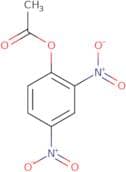
CAS 4232-27-3
:Phenol, 2,4-dinitro-, 1-acetate
Description:
Phenol, 2,4-dinitro-, 1-acetate, with the CAS number 4232-27-3, is an organic compound characterized by its phenolic structure modified by two nitro groups at the 2 and 4 positions and an acetate group at the 1 position. This compound typically appears as a yellow crystalline solid and is known for its relatively high solubility in organic solvents, while being less soluble in water due to the presence of the bulky nitro groups. The nitro substituents contribute to its electron-withdrawing properties, which can influence its reactivity, particularly in electrophilic aromatic substitution reactions. Additionally, the acetate group can participate in various chemical reactions, including hydrolysis and esterification. This compound is of interest in various fields, including organic synthesis and materials science, due to its potential applications in the development of dyes, pharmaceuticals, and agrochemicals. However, it is important to handle it with care, as nitro compounds can be hazardous and may pose environmental risks.
Formula:C8H6N2O6
InChI:InChI=1S/C8H6N2O6/c1-5(11)16-8-3-2-6(9(12)13)4-7(8)10(14)15/h2-4H,1H3
InChI key:InChIKey=CDMLJWCAUSWULM-UHFFFAOYSA-N
SMILES:N(=O)(=O)C1=C(OC(C)=O)C=CC(N(=O)=O)=C1
Synonyms:- 2,4-Dinitrophenyl acetate
- Phenol, 2,4-dinitro-, 1-acetate
- NSC 99812
- Phenol, 2,4-dinitro-, acetate (ester)
- Phenol, 2,4-dinitro-, acetate
Sort by
Purity (%)
0
100
|
0
|
50
|
90
|
95
|
100
Found 4 products.
Phenol, 2,4-dinitro-, 1-acetate
CAS:Formula:C8H6N2O6Purity:98%Color and Shape:SolidMolecular weight:226.14302,4-dinitrophenyl acetate
CAS:2,4-Dinitrophenyl acetate is a reactive compound that is generated by the reduction of 2,4-dinitrophenol. It has been shown to be an effective herbicide that can be used as a pre-emergent or post-emergent herbicide. 2,4-Dinitrophenyl acetate inhibits the uptake of amines by plants and the synthesis of proteins in plants. The mechanism of action is related to its ability to act as a nucleophile and react with the amine group. This compound has been used for kinetic experiments and flow system studies on plant physiology. Intramolecular hydrogen bonding may also be involved in this reaction mechanism.
Formula:C8H6N2O6Purity:Min. 95%Molecular weight:226.14 g/mol