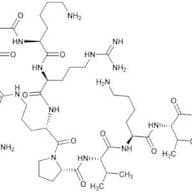
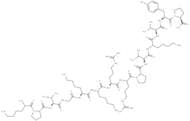
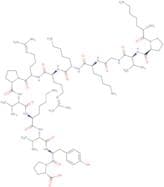
CAS 4237-93-8
:L-lysyl-L-prolyl-L-valylglycyl-L-lysyl-L-lysyl-N~5~-(diaminomethylidene)-L-ornithyl-N~5~-(diaminomethylidene)-L-ornithyl-L-prolyl-L-valyl-L-lysyl-L-valyl-L-tyrosyl-L-proline
Description:
The chemical substance with the name "L-lysyl-L-prolyl-L-valylglycyl-L-lysyl-L-lysyl-N~5~-(diaminomethylidene)-L-ornithyl-N~5~-(diaminomethylidene)-L-ornithyl-L-prolyl-L-valyl-L-lysyl-L-valyl-L-tyrosyl-L-proline" and CAS number 4237-93-8 is a complex peptide composed of multiple amino acids, including lysine, proline, valine, glycine, tyrosine, and ornithine. This substance is characterized by its intricate structure, which includes several peptide bonds linking the amino acids in a specific sequence. The presence of diaminomethylidene groups suggests potential for enhanced biological activity, possibly influencing its interaction with biological systems. Peptides like this one can exhibit various properties, including solubility in water, potential for biological activity, and specific binding affinities depending on their sequence and structure. Such compounds may be of interest in fields like biochemistry, pharmacology, and materials science, particularly for their roles in signaling pathways or as therapeutic agents. However, detailed studies would be necessary to fully understand its properties and potential applications.
Formula:C77H134N24O16
InChI:InChI=1/C77H134N24O16/c1-44(2)60(97-67(108)56-26-17-39-99(56)72(113)49(82)20-7-11-33-78)69(110)89-43-59(103)90-50(21-8-12-34-79)63(104)91-51(22-9-13-35-80)64(105)92-53(24-15-37-87-76(83)84)65(106)94-54(25-16-38-88-77(85)86)73(114)100-40-18-27-57(100)68(109)98-62(46(5)6)70(111)93-52(23-10-14-36-81)66(107)96-61(45(3)4)71(112)95-55(42-47-29-31-48(102)32-30-47)74(115)101-41-19-28-58(101)75(116)117/h29-32,44-46,49-58,60-62,102H,7-28,33-43,78-82H2,1-6H3,(H,89,110)(H,90,103)(H,91,104)(H,92,105)(H,93,111)(H,94,106)(H,95,112)(H,96,107)(H,97,108)(H,98,109)(H,116,117)(H4,83,84,87)(H4,85,86,88)/t49-,50-,51-,52-,53-,54-,55-,56-,57-,58-,60-,61-,62-/m0/s1
SMILES:CC(C)[C@@H](C(=NCC(=N[C@@H](CCCCN)C(=N[C@@H](CCCCN)C(=N[C@@H](CCCNC(=N)N)C(=N[C@@H](CCCNC(=N)N)C(=O)N1CCC[C@H]1C(=N[C@@H](C(C)C)C(=N[C@@H](CCCCN)C(=N[C@@H](C(C)C)C(=N[C@@H](Cc1ccc(cc1)O)C(=O)N1CCC[C@H]1C(=O)O)O)O)O)O)O)O)O)O)O)N=C([C@@H]1CCCN1C(=O)[C@H](CCCCN)N)O
Sort by
Purity (%)
0
100
|
0
|
50
|
90
|
95
|
100
Found 5 products.
ACTH (11-24)
CAS:ACTH (11-24) is a fragment of adrenocorticotropin, acts as an antagonist of adrenocorticotropic hormone (ACTH) receptor, and induces cortisol release.Formula:C77H134N24O16Purity:99.5%Color and Shape:WhiteMolecular weight:1652.06ACTH (11-24)
CAS:ACTH (11-24) is an adrenocorticotrophin fragment, stimulates cortisol, and antagonizes ACTH (1-39)/(1-10) in adrenal cells.Formula:C77H134N24O16Purity:98%Color and Shape:SolidMolecular weight:1652.04ACTH (11-24)
CAS:Custom research peptide; min purity 95%. For different specs please use the Peptide Quote Tool
Formula:C77H134N24O16Molecular weight:1,652.08 g/molACTH (11-24)
CAS:ACTH is a hormone that belongs to the class of endogenous peptides. It is synthesized and secreted by the anterior pituitary gland in response to adrenocorticotropic hormone (ACTH) from the hypothalamus. ACTH has a high affinity for cells with receptors for ACTH and has been shown to stimulate cyclase activity, leading to increased production of cAMP. ACTH also binds to membranes and micelles, which are lipid bilayers with hydrophobic regions. The binding of ACTH at these sites alters the physical properties of these structures by increasing their permeability or solubility. This leads to changes in their functions, including modulation of membrane-bound enzymes such as adenylate cyclase activity.Formula:C77H134N24O16Purity:Min. 95%Molecular weight:1,652.04 g/molADRENOCORTICOTROPIC HORMONE, FRAGMENT 11-24
CAS:Formula:C77H134N24O16Purity:98%Color and Shape:SolidMolecular weight:1652.0390599999996