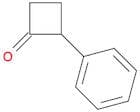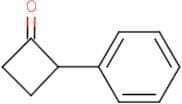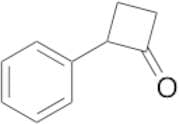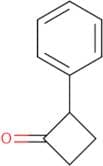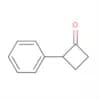
CAS 42436-86-2
:Cyclobutanone, 2-phenyl-
Description:
Cyclobutanone, 2-phenyl- is an organic compound characterized by a cyclobutane ring with a phenyl group attached to the second carbon. It belongs to the class of ketones, which are characterized by the presence of a carbonyl group (C=O). This compound typically exhibits a colorless to pale yellow liquid form and has a distinctive odor. Its molecular structure contributes to its reactivity, making it useful in various chemical syntheses, particularly in the production of pharmaceuticals and agrochemicals. Cyclobutanone derivatives can participate in various reactions, including nucleophilic additions and cycloadditions, due to the strain in the four-membered ring. The presence of the phenyl group can influence the compound's physical properties, such as boiling point and solubility, as well as its chemical reactivity. Safety data indicates that, like many organic compounds, it should be handled with care, as it may pose health risks upon exposure. Overall, cyclobutanone, 2-phenyl- is a valuable compound in organic chemistry with diverse applications.
Formula:C10H10O
Sort by
Purity (%)
0
100
|
0
|
50
|
90
|
95
|
100
Found 5 products.
2-Phenylcyclobutan-1-one
CAS:2-Phenylcyclobutan-1-onePurity:97%Color and Shape:LiquidMolecular weight:146.19g/mol2-Phenylcyclobutan-1-one
CAS:Controlled ProductApplications 2-Phenylcyclobutan-1-one (cas# 42436-86-2) is a useful research chemical.
Formula:C10H10OColor and Shape:NeatMolecular weight:146.182-Phenylcyclobutanone
CAS:2-Phenylcyclobutanone is an organic compound that contains a carbonyl group. It is used as a building block in the synthesis of organic compounds. 2-Phenylcyclobutanone has been shown to be effective in the stereoselective synthesis of enantiopure biomolecules, such as amino acids and peptides. This compound can also be used for the production of chiral cyclic molecules by ring opening. The success of this strategy relies on the availability of both stereoisomers to be able to form diastereomers. This process can be expanded to produce larger rings using different strategies.
Formula:C10H10OPurity:Min. 95%Molecular weight:146.19 g/mol