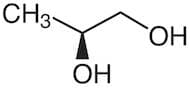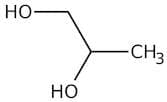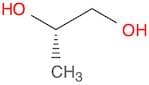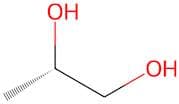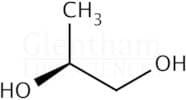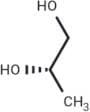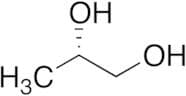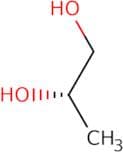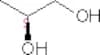
CAS 4254-15-3
:(+)-1,2-Propanediol
Description:
(+)-1,2-Propanediol, also known as propylene glycol, is a colorless, odorless, and hygroscopic liquid with a sweet taste. It is a diol, meaning it contains two hydroxyl (-OH) groups, which contribute to its solubility in water and various organic solvents. This compound is commonly used in food, pharmaceuticals, and cosmetics as a humectant, solvent, and preservative due to its low toxicity and ability to retain moisture. Its chemical formula is C3H8O2, and it has a relatively low boiling point and high boiling point compared to other small organic molecules. The (+) designation indicates that it is the enantiomer with specific optical activity, which can influence its interactions in biological systems. Propylene glycol is also utilized in the production of antifreeze and as a carrier for flavors and fragrances. Its safety profile has been well-studied, and it is generally recognized as safe (GRAS) by regulatory agencies when used appropriately.
Formula:C3H8O2
InChI:InChI=1/C6H12O3/c1-5-3-8-4-6(2-7)9-5/h5-7H,2-4H2,1H3/t5?,6-/m0/s1
InChI key:InChIKey=DNIAPMSPPWPWGF-VKHMYHEASA-N
SMILES:[C@@H](CO)(C)O
Synonyms:- (+)-1,2-Propanediol
- (2S)-1,2-Propanediol
- (2S)-Propane-1,2-diol
- (S)-(+)-1,2-propanediol
- (S)-(+)-Propane-1,2-diol
- (S)-(+)-Propylene glycol
- (S)-2-Hydroxy-1-propanol
- (S)-2-Hydroxypropanol
- 1,2(S)-Propanediol
- 1,2-Propanediol, (2S)-
- 1,2-Propanediol, (S)-
- 3-Deoxy-sn-glycerol
- <span class="text-smallcaps">L</span>-(+)-Propanediol
- <span class="text-smallcaps">L</span>-(+)-Propylene glycol
- <span class="text-smallcaps">L</span>-1,2-Propanediol
- d-Propylene glycol
- L-(+)-Propylene glycol
- PROPYELENE GLYCOL pure
- (S)-(+)-1,2-DIHYDROXYPROPANE
- (S)-(+)-PROPYLENE GLYCEROL
- PROPYLENE GLYCOL extrapure AR
- 1,2-PROPANEDIOL, 1000MG, NEAT
- (S)-(+)-1,2-Propanediol,99%
- (S)-(+)-1,2-Propanediol,97%
- S-1,2-Propancdiol
- ALUMINUM NITRATE NONAHYDRATE 98+% &
- (S)-(+)-PROPANEDIOL
- See more synonyms
Sort by
Purity (%)
0
100
|
0
|
50
|
90
|
95
|
100
Found 10 products.
(S)-(+)-1,2-Propanediol
CAS:Formula:C3H8O2Purity:>98.0%(GC)Color and Shape:Colorless to Light yellow to Light orange clear liquidMolecular weight:76.10(S)-(+)-1,2-Propanediol, 97%
CAS:(S)-(+)-1,2-Propanediol acts as an organic solvent and diluent used in pharmaceutical preparations. It is also used as a chiral synthetic intermediate and substrate for enzyme studies. This Thermo Scientific Chemicals brand product was originally part of the Alfa Aesar product portfolio. Some documeFormula:C3H8O2Purity:97%Color and Shape:Clear colorless, Liquid or viscous liquidMolecular weight:76.10Ref: IN-DA0032FV
5gTo inquire10g21.00€1kg120.00€25g25.00€50g25.00€100g28.00€250g55.00€25kgTo inquire500g73.00€50kgTo inquire(S)-(+)-1,2-Propanediol
CAS:(S)-(+)-1,2-PropanediolFormula:C3H8O2Purity:98%Color and Shape: colourless liquidMolecular weight:76.09g/molS(+)-Propylene glycol
CAS:Formula:C3H8O2Purity:(GC) ≥ 96.0%Color and Shape:Clear, colourless liquidMolecular weight:76.10(S)-(+)-1,2-Propanediol
CAS:(S)-(+)-1,2-Propanediol ((2S)-propane-1,2-diol) is an endogenous compound produced by the engineered bacterium Lactococcus lactis.Formula:C3H8O2Purity:99.23%Color and Shape:Less To Light Yellow Liquid Colorless To Light Yellow LiquidMolecular weight:76.09(S)-(+)-Propane-1,2-diol
CAS:Controlled ProductApplications (S)-(+)-Propane-1,2-diol is a general reagent used in organic synthesis. (S)-(+)-Propane-1,2-diol is used in the synthesis of anti-tuberculosis agents inspired by BTZ043 for MDR resistant strains.
References Tiwari, R. et al.: ACS Med. Chem. Lett., 5, 587 (2014); Tiwari, R. et al.: J. Am. Chem. Soc., 135, 3539 (2013);Formula:C3H8O2Color and Shape:ColourlessMolecular weight:76.09(S)-(+)-1,2-Propanediol
CAS:(S)-(+)-1,2-Propanediol is a diol that is a chemical compound with the molecular formula HOCHCHOH. It has an asymmetric carbon atom and can exist as two enantiomers (S)-(+)-1,2-propanediol and (R)-(-)-1,2-propanediol. The compound is produced in the laboratory by oxidation of propylene with hydrogen peroxide in the presence of a metal catalyst. It undergoes dehydration reactions to form sugars such as erythritol and xylitol. This process also occurs naturally in some plants and bacteria where glucose is oxidized to form glycerol. The conversion of propane-1,2-diol to glycerol is catalyzed by alcohol dehydrogenase from yeast or fungi such as Candida boidinii or Candida kefyr. It also reacts with other molecules such as proteins via amide formation to form new compounds called aFormula:C3H8O2Purity:Min. 98%Color and Shape:Colorless Slightly Yellow Clear LiquidMolecular weight:76.09 g/mol(S)-(+)-1,2-Propanediol
CAS:Formula:C3H8O2Purity:97%Color and Shape:Liquid, ClearMolecular weight:76.095