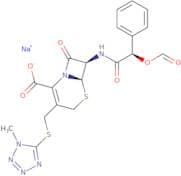
CAS 42540-40-9
:Cefamandole nafate
Description:
Cefamandole nafate is a semisynthetic cephalosporin antibiotic that belongs to the beta-lactam class of antibiotics. It is primarily used to treat a variety of bacterial infections, particularly those caused by Gram-positive and some Gram-negative organisms. Cefamandole nafate is characterized by its broad-spectrum antibacterial activity, which is attributed to its ability to inhibit bacterial cell wall synthesis. The compound is typically administered parenterally, as it is not well absorbed from the gastrointestinal tract. Its pharmacokinetics include a relatively short half-life, necessitating multiple doses for effective treatment. The drug is generally well-tolerated, although it may cause side effects such as allergic reactions, gastrointestinal disturbances, and alterations in liver function tests. Cefamandole nafate is also known for its potential to induce resistance in certain bacterial strains, which is a consideration in antibiotic stewardship. Overall, it is an important therapeutic option in the management of infections, particularly in a hospital setting.
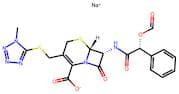
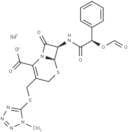
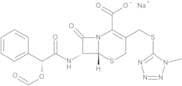
Formula:C19H18N6O6S2·Na
InChI:InChI=1S/C19H18N6O6S2.Na/c1-24-19(21-22-23-24)33-8-11-7-32-17-12(16(28)25(17)13(11)18(29)30)20-15(27)14(31-9-26)10-5-3-2-4-6-10;/h2-6,9,12,14,17H,7-8H2,1H3,(H,20,27)(H,29,30);/t12-,14-,17-;/m1./s1
InChI key:InChIKey=FUWWBXJEMYXCMO-YCLOEFEOSA-N
SMILES:C(O)(=O)C=1N2[C@@]([C@H](NC([C@H](OC=O)C3=CC=CC=C3)=O)C2=O)(SCC1CSC=4N(C)N=NN4)[H].[Na]
Synonyms:- 5-Thia-1-azabicyclo[4.2.0]oct-2-ene-2-carboxylic acid, 7-[[(2R)-(formyloxy)phenylacetyl]amino]-3-[[(1-methyl-1H-tetrazol-5-yl)thio]methyl]-8-oxo-, monosodium salt, (6R,7R)-
- 5-Thia-1-azabicyclo[4.2.0]oct-2-ene-2-carboxylic acid, 7-[[(2R)-2-(formyloxy)-2-phenylacetyl]amino]-3-[[(1-methyl-1H-tetrazol-5-yl)thio]methyl]-8-oxo-, sodium salt (1:1), (6R,7R)-
- 5-Thia-1-azabicyclo[4.2.0]oct-2-ene-2-carboxylic acid, 7-[[(formyloxy)phenylacetyl]amino]-3-[[(1-methyl-1H-tetrazol-5-yl)thio]methyl]-8-oxo-, monosodium salt, [6R-[6α,7β(R*)]]-
- Bergacef
- Cedol
- Cefam
- Cefamandole Nafate
- Cefamandole formate sodium
- Cefiran
- Cemado
- Cemandil
- Cemandil sodium salt
- Cephamandole nafate
- Kefadol
- Kefandol
- Lampomandol
- Mandokef
- Mandol
- Mandolsan
- NSC 299588
- Neocefal
- O-Formylcefamandole sodium
- Pavecef
- Sodium 7-(<span class="text-smallcaps">D</span>-2-formyloxy-2-phenylacetamido)-3-(1-methyl-1H-tetrazol-5-ylthiomethyl)-3-cephem-4-carboxylate
- Sodium O-formylcefamandole
- sodium (6R,7R)-7-{[(2R)-2-(formyloxy)-2-phenylacetyl]amino}-3-{[(1-methyl-1H-tetrazol-5-yl)sulfanyl]methyl}-8-oxo-5-thia-1-azabicyclo[4.2.0]oct-2-ene-2-carboxylate
- sodium (6R,7R)-7-{[(2S)-2-(formyloxy)-2-phenylacetyl]amino}-3-{[(1-methyl-1H-tetrazol-5-yl)sulfanyl]methyl}-8-oxo-5-thia-1-azabicyclo[4.2.0]oct-2-ene-2-carboxylate
- sodium (6R,7R)-7-{[(formyloxy)(phenyl)acetyl]amino}-3-{[(1-methyl-1H-tetrazol-5-yl)sulfanyl]methyl}-8-oxo-5-thia-1-azabicyclo[4.2.0]oct-2-ene-2-carboxylate
- See more synonyms
Sort by
Purity (%)
0
100
|
0
|
50
|
90
|
95
|
100
Found 8 products.
CEFAMANDOLE NAFATE CRS
CAS:CEFAMANDOLE NAFATE CRSFormula:C19H17N6NaO6S2Color and Shape:White. Powder.Molecular weight:512.4946Sodium (6R,7R)-7-(R)-mandelamido-3-[[(1-methyl-1H-tetrazol-5-yl)thio]methyl]-8-oxo-5-thia-1-azabicyclo[4.2.0]oct-2-ene-2-carboxylate formate (ester)
CAS:Formula:C19H17N6NaO6S2Purity:98%Color and Shape:SolidMolecular weight:512.4946Cefamandole nafate
CAS:Formula:C19H17N6O6S2NaColor and Shape:White to off-white powderMolecular weight:512.49Cefamandole nafate
CAS:Cefamandole nafate (Cephamandole nafate) is a second-generation broad-spectrum cephalosporin antibiotic.Formula:C19H17N6NaO6S2Purity:97.47%Color and Shape:White SolidMolecular weight:512.49Cefamandole Nafate
CAS:Controlled ProductApplications Antibacterial.
References Taha, M., et al.: Bioorg. Med. Chem., 16, 1218 (2008), Gohil, V., et al.: Nat. Biotechnol., 28, 249 (2010),Formula:C19H17N6O6S2·NaColor and Shape:NeatMolecular weight:512.49Cefamandole nafate
CAS:Cefamandole nafate is an antimicrobial agent that is used for the treatment of infectious diseases. It has a broad spectrum of activity and is effective against Gram-positive and Gram-negative bacteria, such as staphylococci, streptococci, and pseudomonads. Cefamandole nafate has been shown to be active against tissue infection caused by E. coli in rats. The mechanism of action involves cell lysis and the formation of sodium carbonate. This reaction takes place when glucose is injected into the animal's intrauterine cavity before injecting cefamandole nafate solution. The chemical reaction between sodium carbonate and glucose produces water, carbon dioxide, sodium bicarbonate, and hydrogen ions. The hydrogen ions react with cefamandole to produce its active form, which then reacts with the bacterial cell wall by disrupting the cell membrane. Cefamandole nafate also inhibits protein synthesis by bindingFormula:C19H17N6O6S2•NaPurity:Min. 95%Color and Shape:PowderMolecular weight:512.49 g/molCefamandole Nafate (DISCONTINUED)
CAS:Antibiotics nesoiFormula:C19H18N6O6S2·NaColor and Shape:Crystalline SolidMolecular weight:513.06269


![Sodium (6R,7R)-7-(R)-mandelamido-3-[[(1-methyl-1H-tetrazol-5-yl)thio]methyl]-8-oxo-5-thia-1-azabic…](/_next/image/?url=https%3A%2Fstatic.cymitquimica.com%2Fproducts%2FIN%2Fthumb%2FDA00I88D.jpg&w=3840&q=75)