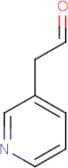
CAS 42545-63-1
:3-Pyridineacetaldehyde
Description:
3-Pyridineacetaldehyde, also known as 3-pyridine-2-carboxaldehyde, is an organic compound characterized by its pyridine ring structure with an aldehyde functional group attached to the carbon adjacent to the nitrogen atom. It has a molecular formula that reflects its composition of carbon, hydrogen, and nitrogen atoms. This compound typically appears as a colorless to pale yellow liquid with a distinctive odor. It is soluble in organic solvents and exhibits moderate solubility in water. 3-Pyridineacetaldehyde is known for its reactivity, particularly in condensation reactions, and can serve as an intermediate in the synthesis of various pharmaceuticals and agrochemicals. Its properties include a relatively low boiling point and a tendency to participate in electrophilic aromatic substitution due to the electron-withdrawing nature of the aldehyde group. Safety data indicates that it should be handled with care, as it may cause irritation to the skin and eyes. Overall, 3-Pyridineacetaldehyde is a valuable compound in organic synthesis and chemical research.
Formula:C7H7NO
Sort by
Purity (%)
0
100
|
0
|
50
|
90
|
95
|
100
Found 4 products.
2-(Pyridin-3-yl)acetaldehyde
CAS:2-(Pyridin-3-yl)acetaldehydePurity:≥95%Color and Shape:LiquidMolecular weight:121.14g/molPyridin-3-ylacetaldehyde
CAS:Controlled ProductFormula:C7H7NOColor and Shape:NeatMolecular weight:121.137Pyridin-3-ylacetaldehyde Bisulfate Adduct (~90%)
CAS:Controlled ProductApplications Pyridin-3-ylacetaldehyde Bisulfate Adduct is the bisulfate form of Pyridin-3-ylacetaldehyde Sodium Salt (P991755), which is used in the synthesis of CB1/CB2 agonist that can be applied to the treatment of chronic pain. Used in the synthesis of 3-Substituted quinoline derivatives.
References Cheng, Y. et al.: Bioorg. Med. Chem. Lett., 22, 1619 (2012); Maguire, M. et al.: J. Med. Chem., 37, 2129 (1994);Formula:C7H8NNaO4SPurity:~90%Color and Shape:NeatMolecular weight:225.2