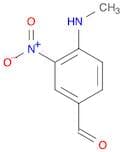
CAS 42564-41-0
:4-(methylamino)-3-nitrobenzaldehyde
Description:
4-(Methylamino)-3-nitrobenzaldehyde, with the CAS number 42564-41-0, is an organic compound characterized by its aromatic structure, which includes a benzaldehyde group substituted with both a methylamino group and a nitro group. The presence of the methylamino group introduces basic properties, while the nitro group contributes to its electron-withdrawing characteristics, influencing its reactivity and solubility. This compound typically appears as a solid at room temperature and is soluble in polar organic solvents. It is often used in organic synthesis and may serve as an intermediate in the production of dyes, pharmaceuticals, or other chemical compounds. The compound's reactivity can be attributed to the functional groups present, allowing for various chemical transformations, including nucleophilic substitutions and reductions. Safety precautions should be taken when handling this substance, as it may pose health risks, including potential toxicity. Proper storage conditions and handling protocols are essential to ensure safety and stability.
Formula:C8H8N2O3
InChI:InChI=1/C8H8N2O3/c1-9-7-3-2-6(5-11)4-8(7)10(12)13/h2-5,9H,1H3
SMILES:CNc1ccc(cc1N(=O)=O)C=O
Synonyms:- 4-Methylamino-3-nitro-benzaldehyde
Sort by
Purity (%)
0
100
|
0
|
50
|
90
|
95
|
100
Found 2 products.
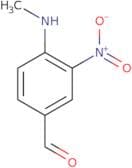
4-Methylamino-3-nitrobenzaldehyde
CAS:4-Methylamino-3-nitrobenzaldehyde is a luminescent compound that can be used in the detection of oxidative metabolites. It is a mediator oxidation product of 4-methylaminobenzaldehyde and has been shown to be aerobic and phosphotungstic. This compound is recycled and does not interfere with other analytical methods. It can also be immobilized on a surface, such as silica gel or magnesium oxide, or immobilized in an acidic environment. The phosphotungstic acid used for this immobilization process is a biomimetic metal ion complex that has been modified to react with the triazole derivative.Formula:C8H8N2O3Purity:Min. 95%Molecular weight:180.16 g/mol