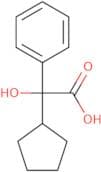
CAS 427-49-6
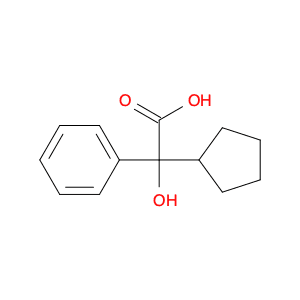
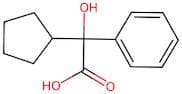
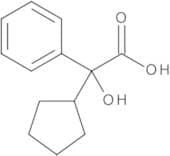
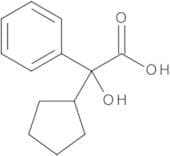
:α-Cyclopentylmandelic acid
Description:
α-Cyclopentylmandelic acid, with the CAS number 427-49-6, is an organic compound characterized by its unique cyclopentyl group attached to the mandelic acid structure. This compound features a chiral center, which contributes to its potential optical activity. It typically appears as a white to off-white crystalline solid and is soluble in polar solvents, such as water and alcohols, due to the presence of the carboxylic acid functional group. The cyclopentyl moiety can influence the compound's hydrophobicity and biological activity, making it of interest in medicinal chemistry and drug design. α-Cyclopentylmandelic acid may exhibit various biological properties, including antimicrobial or anti-inflammatory effects, although specific activities can vary based on structural modifications and the presence of substituents. Its synthesis often involves the reaction of cyclopentyl derivatives with mandelic acid or its precursors. As with many organic acids, it can participate in acid-base reactions and form salts with bases, which can be relevant for its applications in pharmaceuticals and organic synthesis.
Formula:C13H16O3
InChI:InChI=1S/C13H16O3/c14-12(15)13(16,11-8-4-5-9-11)10-6-2-1-3-7-10/h1-3,6-7,11,16H,4-5,8-9H2,(H,14,15)
InChI key:InChIKey=WFLUEQCOAQCQLP-UHFFFAOYSA-N
SMILES:C(C(O)=O)(O)(C1=CC=CC=C1)C2CCCC2
Synonyms:- (2R)-cyclopentyl(hydroxy)phenylethanoate
- (2S)-cyclopentyl(hydroxy)phenylethanoate
- (±)-Cyclopentylmandelic acid
- 2-Cyclopentyl-2-hydroxy-2-(phenyl)acetic acid
- 2-Cyclopentyl-2-hydroxy-2-phenylacetic acid
- 2-Cyclopentylmandelic acid
- Benzeneacetic acid, α-cyclopentyl-α-hydroxy-
- Cyclopentyl(Hydroxy)Phenylacetic Acid
- Cyclopentylhydroxyphenylacetic acid
- Mandelic acid, α-cyclopentyl-
- NSC 96637
- alpha-Cyclopentylmandelic acid
- α-Cyclopentyl-α-hydroxybenzeneacetic acid
- α-Cyclopentylmandelic acid
- ALFA-CYCLOPENTYLMANDELIC ACID
- See more synonyms
Sort by
Purity (%)
0
100
|
0
|
50
|
90
|
95
|
100
Found 11 products.
α-Cyclopentyl-DL-mandelic Acid
CAS:Formula:C13H16O3Purity:>98.0%(T)(HPLC)Color and Shape:White to Light yellow powder to crystalMolecular weight:220.27Glycopyrrolate Related Compound C (2-Cyclopentyl-2-hydroxy-2-phenylacetic acid)
CAS:Carboxylic acids w/ alcohol function but w/o other oxygen function and their derivatives, nesoiFormula:C13H16O3Color and Shape:White Off-White PowderMolecular weight:220.109942-Cyclopentyl-2-hydroxy-2-phenylacetic acid
CAS:Formula:C13H16O3Purity:96%Color and Shape:SolidMolecular weight:220.2643Glycopyrronium Bromide EP Impurity J (Glycopyrrolate USP Related Compound C)
CAS:Formula:C13H16O3Color and Shape:Off-White SolidMolecular weight:220.272-Cyclopentyl-2-hydroxy-2-phenylacetic acid
CAS:2-Cyclopentyl-2-hydroxy-2-phenylacetic acidPurity:98%Molecular weight:220.27g/mol2-(RS)-Cyclopentyl-2-hydroxy-2-phenylacetic Acid (α-Cyclopentylmandelic Acid)
CAS:Color and Shape:Neat2-Cyclopentyl-2-hydroxy-2-phenylacetic Acid
CAS:Applications 2-Cyclopentyl-2-hydroxy-2-phenylacetic Acid is an impurity of Glycopyrrolate (G657000), a novel pharmaceutical compound based on PDE IV inhibitors; used in the treatment of respiratory complaints. It is used in the synthesis of muscarinic M3 receptor antagonists.
References Gomez, et al.: Br. J. Anaesth., 74, 549 (1995); Kumar, N. et al.: Bioorg. Med. Chem. Lett., 17, 5256 (2007);Formula:C13H16O3Color and Shape:Off White To Light BrownMolecular weight:220.26Cyclopentylmandelic acid
CAS:Cyclopentylmandelic acid (CPM) is a bifunctional drug that binds to the receptors of the adrenergic system and acts as an agonist. It has been shown to have a matrix effect, which stabilizes and minimizes the effects of other drugs. CPM can also reduce carbonyl groups in the body, which are linked to stress and aging. CPM is a synthetic drug that was first isolated by chromatography. The structural formula for this drug is similar to that of cyclopentanol, with the exception of one methyl group on its side chain. CPM has been shown to have anticholinergic properties, meaning it blocks acetylcholine receptors in nerve cells and leads to dry mouth, blurred vision, constipation, and urinary retention.Formula:C13H16O3Color and Shape:White PowderMolecular weight:220.27 g/mol