CAS 4277-34-3
:4-Cycloocten-1-ol
Description:
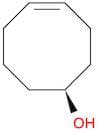
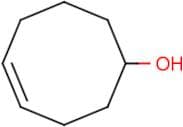
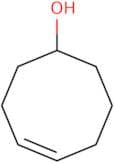
4-Cycloocten-1-ol is a cyclic organic compound characterized by its unique structure, which includes a cyclooctene ring with a hydroxyl (-OH) group attached at the first carbon position. This compound is classified as an alcohol due to the presence of the hydroxyl group, which imparts certain properties such as increased polarity and the ability to engage in hydrogen bonding. As a result, 4-cycloocten-1-ol exhibits moderate solubility in water and is more soluble in organic solvents. The compound is typically a colorless to pale yellow liquid with a distinctive odor. Its molecular structure contributes to its reactivity, making it a potential intermediate in organic synthesis and a candidate for various chemical reactions, including oxidation and esterification. Additionally, 4-cycloocten-1-ol may have applications in the fragrance industry and as a building block in the synthesis of more complex molecules. Safety data should be consulted for handling and storage, as with any chemical substance.
Formula:C8H14O
InChI:InChI=1S/C8H14O/c9-8-6-4-2-1-3-5-7-8/h1-2,8-9H,3-7H2
InChI key:InChIKey=UCPDHOTYYDHPEN-UHFFFAOYSA-N
SMILES:OC1CCCC=CCC1
Synonyms:- (4Z)-cyclooct-4-en-1-ol
- 1-Hydroxy-4-cyclooctene
- 1-Hydroxy-5-cyclooctene
- 4-Cycloocten-1-ol
- 4-Cyclooctenol
- 5-Hydroxy-1-cyclooctene
- 5-Hydroxycycloctene
- 5-Hydroxycyclooctene
- Cycloocten-5-ol
- NSC 119487
Sort by
Purity (%)
0
100
|
0
|
50
|
90
|
95
|
100
Found 5 products.
5-Hydroxy-1-cyclooctene
CAS:5-Hydroxy-1-cyclooctene is a monomer of polymers that can be used to introduce new properties to polymers. It is also an effective surface modifier, which can be used to modify the surface properties of polymeric materials. 5-Hydroxy-1-cyclooctene has been shown to bind to calcium ions and may have potential for use in active targeting and as a neutral pH probe. The polymer concentration influences the x-ray structure, which has been studied using x-ray diffraction methods. The absorption spectrum of 5-hydroxy-1-cyclooctene has been examined in vitro and it has been found that this molecule absorbs light in the visible region at wavelengths between 400 nm and 700 nm. It also emits luminescence with a maximum peak at 690 nm. The second order rate constant for the reaction with ruthenium complex is 2.2×10^8 M^(-1)s^(-1). ThisFormula:C8H14OPurity:Min. 95%Color and Shape:Clear LiquidMolecular weight:126.2 g/mol