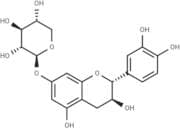
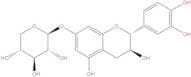
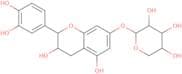
CAS 42830-48-8
:(2R,3S)-2-(3,4-dihydroxyphenyl)-3,5-dihydroxy-3,4-dihydro-2H-chromen-7-yl beta-D-xylopyranoside
Description:
The chemical substance known as (2R,3S)-2-(3,4-dihydroxyphenyl)-3,5-dihydroxy-3,4-dihydro-2H-chromen-7-yl beta-D-xylopyranoside, with the CAS number 42830-48-8, is a glycoside that features a chromen-7-yl moiety linked to a beta-D-xylopyranoside unit. This compound exhibits multiple hydroxyl groups, which contribute to its potential antioxidant properties and biological activities. The stereochemistry indicated by the (2R,3S) configuration suggests specific spatial arrangements of atoms that can influence the compound's reactivity and interactions with biological targets. The presence of the dihydroxyphenyl group enhances its potential for engaging in hydrogen bonding and other intermolecular interactions. Such compounds are often studied for their pharmacological effects, including anti-inflammatory and anti-cancer properties. Additionally, the glycosidic bond in this structure may affect its solubility and bioavailability, making it a subject of interest in medicinal chemistry and natural product research.
Formula:C20H22O10
InChI:InChI=1/C20H22O10/c21-11-2-1-8(3-13(11)23)19-14(24)6-10-12(22)4-9(5-16(10)30-19)29-20-18(27)17(26)15(25)7-28-20/h1-5,14-15,17-27H,6-7H2/t14-,15+,17-,18+,19+,20-/m0/s1
Synonyms:- .beta.-D-Xylopyranoside, (2R,3S)-2-(3,4-dihydroxyphenyl)-3,4-dihydro-3,5-dihydroxy-2H-1-benzopyran-7-yl
- 2-(3,4-dihydroxyphenyl)-3,5-dihydroxy-3,4-dihydro-2H-chromen-7-yl pentopyranoside
- Catechin 7-xyloside
Sort by
Purity (%)
0
100
|
0
|
50
|
90
|
95
|
100
Found 5 products.
Catechin-7-O-xyloside
CAS:C7Ox, an anti-cancer agent, triggers apoptosis in H1299 lung cancer cells through ER stress and mitochondrial damage.Formula:C20H22O10Purity:98%Color and Shape:SolidMolecular weight:422.38Catechin 7-xyloside
CAS:Catechin 7-xyloside is a flavonoid glycoside, which is a derivative of catechin, primarily sourced from various plant materials that are rich in flavonoids. Catechin is a natural polyphenolic compound commonly found in tea, cocoa, and various fruits. The glycosidic form, Catechin 7-xyloside, involves the attachment of a sugar moiety, xyloside, to the catechin molecule. This structural modification is known to influence the compound's solubility, stability, and bioavailability.Formula:C20H22O10Purity:Min. 95%Molecular weight:422.4 g/mol