CAS 4290-87-3
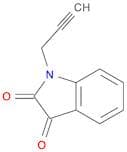
:1-(prop-2-yn-1-yl)-1H-indole-2,3-dione
Description:
1-(Prop-2-yn-1-yl)-1H-indole-2,3-dione, also known by its CAS number 4290-87-3, is an organic compound that features an indole core substituted with a propargyl group. This compound exhibits a unique structure characterized by the presence of a dione functional group, which contributes to its reactivity and potential biological activity. The indole moiety is known for its role in various natural products and pharmaceuticals, often exhibiting significant pharmacological properties. The propargyl substituent can enhance the compound's reactivity, making it a candidate for further chemical transformations or applications in medicinal chemistry. Additionally, compounds with indole structures are often studied for their potential in treating various diseases, including cancer and neurological disorders. The physical properties, such as solubility and melting point, can vary based on the specific conditions and purity of the compound. Overall, 1-(prop-2-yn-1-yl)-1H-indole-2,3-dione represents a versatile scaffold in organic synthesis and medicinal chemistry.
Formula:C11H7NO2
InChI:InChI=1/C11H7NO2/c1-2-7-12-9-6-4-3-5-8(9)10(13)11(12)14/h1,3-6H,7H2
SMILES:C#CCN1c2ccccc2C(=O)C1=O
Synonyms:- 1H-indole-2,3-dione, 1-(2-propyn-1-yl)-
Sort by
Purity (%)
0
100
|
0
|
50
|
90
|
95
|
100
Found 3 products.
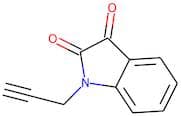
1-(prop-2-yn-1-yl)-2,3-dihydro-1H-indole-2,3-dione
CAS:Formula:C11H7NO2Color and Shape:SolidMolecular weight:185.17881-(Prop-2-yn-1-yl)-2,3-dihydro-1H-indole-2,3-dione
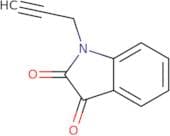
CAS:1-(Prop-2-yn-1-yl)-2,3-dihydro-1H-indole-2,3-dionePurity:95%Molecular weight:185.18g/mol1-(2-Propynyl)-1H-indole-2,3-dione
CAS:1-(2-Propynyl)-1H-indole-2,3-dione is a hydrophobic molecule that has been shown to have anticancer activity in vitro. It causes cancer cells to undergo programmed cell death by interacting with the cellular mitochondria and triggering apoptosis. The molecule also interacts with serum albumin, which may be related to its ability to enter cells. 1-(2-Propynyl)-1H-indole-2,3-dione has been shown to cause DNA damage by binding to the x-ray crystallography of microbial strains, as well as by irradiation in the presence of azides. This molecule has a fluorescent substructure that can be detected using bovine serum albumin fluorescence.Formula:C11H7NO2Purity:Min. 95%Molecular weight:185.18 g/mol