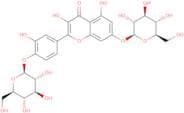
CAS 42900-82-3
:Quercetin 7,4′-diglucoside
Description:
Quercetin 7,4′-diglucoside, also known as quercetrin, is a flavonoid glycoside characterized by its structure, which consists of a quercetin molecule linked to two glucose units. This compound is primarily found in various plants, particularly in fruits, vegetables, and herbs, contributing to their antioxidant properties. Quercetin 7,4′-diglucoside exhibits several biological activities, including anti-inflammatory, antioxidant, and potential anticancer effects, making it of interest in nutritional and pharmaceutical research. It is soluble in water and exhibits stability under various pH conditions, although its bioavailability can be limited due to its glycosylated form. The compound is often studied for its health benefits, including its role in reducing oxidative stress and modulating immune responses. As a natural product, it is considered safe for consumption, but further studies are needed to fully understand its mechanisms of action and therapeutic potential.
Formula:C27H30O17
InChI:InChI=1S/C27H30O17/c28-6-14-17(32)20(35)23(38)26(43-14)40-9-4-11(31)16-13(5-9)41-25(22(37)19(16)34)8-1-2-12(10(30)3-8)42-27-24(39)21(36)18(33)15(7-29)44-27/h1-5,14-15,17-18,20-21,23-24,26-33,35-39H,6-7H2/t14-,15-,17-,18-,20+,21+,23-,24-,26-,27-/m1/s1
InChI key:InChIKey=QZXHFNCQMMUANB-UINLEYECSA-N
SMILES:O=C1C=2C(OC(=C1O)C3=CC(O)=C(O[C@@H]4O[C@H](CO)[C@@H](O)[C@H](O)[C@H]4O)C=C3)=CC(O[C@@H]5O[C@H](CO)[C@@H](O)[C@H](O)[C@H]5O)=CC2O
Synonyms:- Quercetin 7,4′-diglucoside
- Flavone, 3,3′,4′,5,7-pentahydroxy-, 4′,7-diglucoside
- 4H-1-Benzopyran-4-one, 7-(β-D-glucopyranosyloxy)-2-[4-(β-D-glucopyranosyloxy)-3-hydroxyphenyl]-3,5-dihydroxy-
- Quercetin 4′,7-diglucoside
- 7-(β-D-Glucopyranosyloxy)-2-[4-(β-D-glucopyranosyloxy)-3-hydroxyphenyl]-3,5-dihydroxy-4H-1-benzopyran-4-one
Sort by
Purity (%)
0
100
|
0
|
50
|
90
|
95
|
100
Found 1 products.
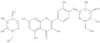
Quercetin-7,4'-diglucoside
CAS:Quercetin-7,4'-diglucoside is a flavonoid glycoside, which is a bioactive compound derived from various plants, particularly in fruits, vegetables, and certain leaves. It functions through its ability to modulate cellular pathways related to oxidative stress and inflammation, acting as a potent antioxidant and anti-inflammatory agent. These modes of action are primarily attributed to its capacity to scavenge free radicals and attenuate the expression of pro-inflammatory cytokines by interfering with signaling pathways, such as NF-κB and MAPK.
Formula:C27H30O17Purity:Min. 90%Color and Shape:Clear LiquidMolecular weight:626.52 g/mol