CAS 42952-91-0
:N-NitrosodiphenylaMine-d10
Description:
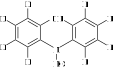
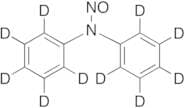
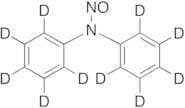
N-Nitrosodiphenylamine-d10 is a deuterated derivative of N-nitrosodiphenylamine, a compound known for its potential carcinogenic properties. This substance is characterized by the presence of a nitroso group (-NO) attached to a diphenylamine structure, which consists of two phenyl rings connected by an amine group. The "d10" designation indicates that the compound contains ten deuterium atoms, which are isotopes of hydrogen, replacing the regular hydrogen atoms in the molecule. This isotopic labeling is often used in research to trace chemical pathways or to study reaction mechanisms. N-Nitrosodiphenylamine itself is recognized for its stability and solubility in organic solvents, making it useful in various chemical applications, including as an intermediate in the synthesis of other compounds. However, due to its potential health risks, handling and disposal of this compound must be conducted with caution, adhering to safety regulations to minimize exposure.
Formula:C12H10N2O
Synonyms:- N-NitrosodiphenylaMine-d10
- N-NitrosodiphenylaMine-d10 ISO 9001:2015 REACH
- N-Nitrosobis(pentadeuteriophenyl)amin
- [2H10]-N-Nitrosodiphenylamine
- UBUCNCOMADRQHX-LHNTUAQVSA-N
Sort by
The purity filter is not visible because current products do not have associated purity data for filtering.
Found 3 products.
N-Nitroso-diphenylamine D10
CAS:Controlled ProductFormula:C12H10N2OColor and Shape:NeatMolecular weight:208.28N-Nitrosodiphenylamine-d10
CAS:Controlled ProductApplications Isotope labelled N-Nitrosodiphenylamine (N525775), which is the N-nitroso analogue of diphenylamine that was once used as a rubber additive but is no longer due to undesirable carcinogenic effects (1). N-Nitrosodiphenylamine may have potential carcinogenic activity and is currently classified as a probable carcinogen by EPA with genetic toxicity (2,3).Drinking water contaminant candidate list 3 (CCL 3) compound as per United States Environmental Protection Agency (EPA), environmental, and food contaminants.
References 1. Boyland, D. et al.: Eur. J. Cancer. 1968. May;4(2):233-2342. Iversen, O. et al.: Eur. J. Cancer. 1980 May;16(5):695-8.3. McGregor, D. et al.: Mutat. Res. Rev. Gen. Toxicol. 1994 Jun:317(3):195-211Formula:C122H10N2OColor and Shape:YellowMolecular weight:208.28