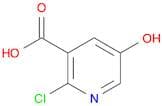
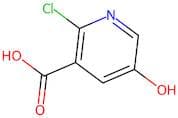
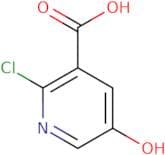
CAS 42959-40-0
:2-chloro-5-hydroxypyridine-3-carboxylic acid
Description:
2-Chloro-5-hydroxypyridine-3-carboxylic acid, with the CAS number 42959-40-0, is a heterocyclic organic compound featuring a pyridine ring substituted with a chlorine atom, a hydroxyl group, and a carboxylic acid group. This compound typically exhibits characteristics common to pyridine derivatives, such as moderate solubility in polar solvents due to the presence of the hydroxyl and carboxylic acid functional groups. The chlorine substituent can influence the compound's reactivity and polarity. The hydroxyl group contributes to its potential as a hydrogen bond donor, while the carboxylic acid group can act as a hydrogen bond acceptor, enhancing its interactions in biological systems or with other molecules. This compound may be of interest in pharmaceutical research and synthesis due to its potential biological activity and ability to serve as a building block for more complex molecules. Its specific applications and reactivity would depend on the context of its use in chemical synthesis or biological studies.
Formula:C6H4ClNO3
InChI:InChI=1/C6H4ClNO3/c7-5-4(6(10)11)1-3(9)2-8-5/h1-2,9H,(H,10,11)
SMILES:c1c(cnc(c1C(=O)O)Cl)O
Synonyms:- 2-Chloro-5-hydroxynicotinic acid
- 3-Pyridinecarboxylic Acid, 2-Chloro-5-Hydroxy-
- 42959-40-0
Sort by
Purity (%)
0
100
|
0
|
50
|
90
|
95
|
100
Found 4 products.
2-CHLORO-5-HYDROXYNICOTINIC ACID
CAS:Formula:C6H4ClNO3Purity:95%Color and Shape:SolidMolecular weight:173.55392-Chloro-5-hydroxynicotinic acid
CAS:2-Chloro-5-hydroxynicotinic acidPurity:95%Molecular weight:173.56g/mol2-Chloro-5-hydroxynicotinic acid
CAS:Formula:C6H4ClNO3Purity:95%Color and Shape:No data available.Molecular weight:173.552-Chloro-5-hydroxynicotinic acid
CAS:2-Chloro-5-hydroxynicotinic acid is a chemical compound that has been isolated from the bark of the plant Cinchona officinalis. It is an intermediate in the biosynthesis of quinine and other cinchona alkaloids. 2-Chloro-5-hydroxynicotinic acid is also used as an intermediate in the synthesis of other compounds, including herbicides and pesticides.
Formula:C6H4ClNO3Purity:Min. 95%Molecular weight:173.55 g/mol