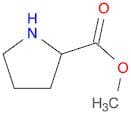
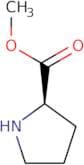
CAS 43041-12-9
:D-Proline methyl ester
Description:
D-Proline methyl ester is a chemical compound that belongs to the class of amino acid derivatives, specifically an ester of the amino acid proline. It is characterized by its molecular structure, which includes a proline backbone with a methyl ester functional group. This compound is typically a white to off-white solid and is soluble in polar organic solvents, making it useful in various chemical reactions and syntheses. D-Proline methyl ester is often employed in peptide synthesis and as a chiral building block in organic chemistry due to its ability to introduce stereochemistry into molecules. Additionally, it may exhibit biological activity, as proline and its derivatives are involved in various metabolic processes. The compound's properties, such as melting point, boiling point, and reactivity, can vary based on purity and environmental conditions. As with many chemical substances, proper handling and safety precautions are essential when working with D-Proline methyl ester in laboratory settings.
Formula:C6H11NO2
InChI:InChI=1S/C6H11NO2/c1-9-6(8)5-3-2-4-7-5/h5,7H,2-4H2,1H3/t5-/m1/s1
InChI key:InChIKey=BLWYXBNNBYXPPL-RXMQYKEDSA-N
SMILES:C(OC)(=O)[C@H]1CCCN1
Synonyms:- (R)-Proline methyl ester
- (R)-Pyrrolidine-2-carboxylic acid methyl ester
- D-Proline methyl ester
- D-Proline, methyl ester
- Methyl D-prolinate
Sort by
Purity (%)
0
100
|
0
|
50
|
90
|
95
|
100
Found 3 products.
(R)-Methyl pyrrolidine-2-carboxylate
CAS:(R)-Methyl pyrrolidine-2-carboxylate is an organic compound that belongs to the class of hydroxamic acids. It is a white crystalline solid that has been isolated from the leaves of the plant "Pteris ensiformis" (a fern). This compound has been shown to be a potent inhibitor of cancer cell growth in vitro. The structure of the molecule contains a carbonyl group and a stereoselective center at C4. The surface properties of this analog have been studied using spectroscopic techniques, such as NMR and FTIR, which show that there are no significant changes in its surface properties with respect to its analogs. Electropolymerization experiments have shown that this compound can be immobilized on low energy surfaces and used in molecular modeling studies.Formula:C6H11NO2Purity:Min. 95%Molecular weight:129.16 g/mol