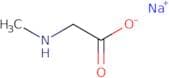
CAS 4316-73-8
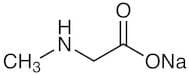
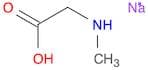
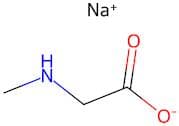
:Sodium sarcosinate
- Glycine, N-methyl-, monosodium salt
- Glycine, N-methyl-, sodium salt (1:1)
- Sarcosine sodium
- Sarcosine sodium salt
- Sarcosine, monosodium salt
- Sodium (Methylamino)Acetate
- Sodium N-(methylamino)acetate
- Sodium N-methylglycinate
- Sodium Sarcosine
Sarcosine Sodium Salt (ca. 35% in Water)
CAS:Formula:C3H6NNaO2Color and Shape:Colorless to Light yellow clear liquidMolecular weight:111.08Sarcosine Sodium Salt (ca. 35% in Water)
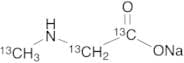
CAS:Sarcosine Sodium Salt (ca. 35% in Water)Purity:90%Molecular weight:111.08g/molSarcosine Sodium Salt-13C3
CAS:Controlled ProductFormula:C3H6NNaO2Color and Shape:NeatMolecular weight:114.053Sodium sarcosinate - ca. 40% in water
CAS:Sodium sarcosine is a salt of sarcosine with sodium. It has an average molecular weight of 255 and is soluble in water. Sodium sarcosine is used as a biological sample for non-steroidal anti-inflammatory drugs (NSAIDs) in the study of their inhibitory properties against mammalian DNA polymerase. NSAIDs are also used to treat inflammation, pain, and fever by inhibiting prostaglandin synthesis. The rate constant for the reaction between NSAIDs and DNA polymerase was found to be 1.6x10^-4 M^-1s^-1 at 25°C, which is close to the Km value for the reaction. This finding indicates that NSAIDs may be competitive inhibitors of the enzyme, although further experiments are needed to confirm this hypothesis. Using electrochemical impedance spectroscopy, it was found that NSAIDs have a higher affinity for divalent cations than monovalent cations, suggesting that they bind to a site on the
Formula:C3H6NNaO2Purity:Min. 95%Color and Shape:Colorless Clear LiquidMolecular weight:111.08 g/molRef: 3D-FS02729
Discontinued product