CAS 43216-12-2
:2-(iodomethyl)tetrahydro-2H-pyran
Description:
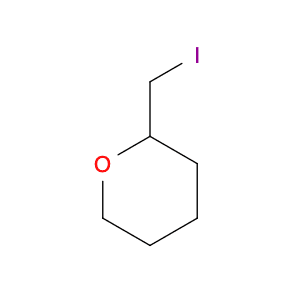
2-(Iodomethyl)tetrahydro-2H-pyran is a chemical compound characterized by its tetrahydrofuran-like structure, which includes a pyran ring. This compound features an iodomethyl group, which introduces a halogen atom (iodine) into its molecular framework, enhancing its reactivity and potential applications in organic synthesis. The presence of the iodomethyl group can facilitate nucleophilic substitution reactions, making it useful in the formation of carbon-carbon bonds. The compound is typically a colorless to pale yellow liquid, exhibiting moderate polarity due to the oxygen atom in the pyran ring. Its molecular structure contributes to its potential as an intermediate in the synthesis of various organic compounds, including pharmaceuticals and agrochemicals. Additionally, the compound's stability and reactivity can be influenced by factors such as temperature and solvent choice. Safety precautions should be taken when handling this substance, as iodine can pose health risks, and proper storage conditions are essential to maintain its integrity.
Formula:C6H11IO
InChI:InChI=1/C6H11IO/c7-5-6-3-1-2-4-8-6/h6H,1-5H2
SMILES:C1CCOC(C1)CI
Synonyms:- 2-(Iodomethyl)tetrahydropyran
Sort by
Purity (%)
0
100
|
0
|
50
|
90
|
95
|
100
Found 4 products.
2-(Iodomethyl)tetrahydropyran
CAS:Formula:C6H11IOPurity:98%Color and Shape:LiquidMolecular weight:226.05542-(Iodomethyl)tetrahydro-2H-pyran
CAS:2-(Iodomethyl)tetrahydro-2H-pyranPurity:98% (stabilized with Cu)Molecular weight:226.06g/mol2-(Iodomethyl)tetrahydro-2H-pyran
CAS:Formula:C6H11IOPurity:98% (stabilized with Cu)Molecular weight:226.0572-(Iodomethyl)oxane
CAS:2-(Iodomethyl)oxane is an iodinated derivative of oxane. It is a quinoline derivative, which is a class of drugs that inhibit the activity of the 5-HT4 receptor. This receptor has been shown to be associated with epidermoid carcinoma and Alzheimer's disease. 2-(Iodomethyl)oxane has been found to have potent cardiovascular effects in animal studies, and may be a potential treatment for cardiac disorders and kidney cancer. In addition, it has been shown to exhibit surfactant activity, which may contribute to its anticancer effects.Formula:C6H11IOPurity:Min. 95%Molecular weight:226.06 g/mol