CAS 433922-57-7
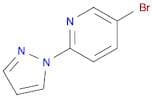
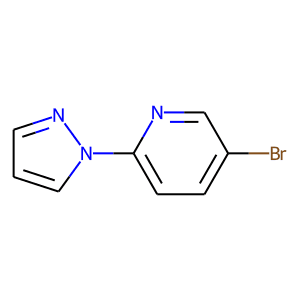
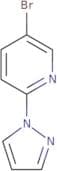
:5-bromo-2-(1H-pyrazol-1-yl)pyridine
Description:
5-Bromo-2-(1H-pyrazol-1-yl)pyridine is a heterocyclic organic compound characterized by the presence of both a bromine atom and a pyrazole moiety attached to a pyridine ring. The compound features a bromine substituent at the 5-position of the pyridine ring, which enhances its reactivity and potential for further chemical modifications. The pyrazole group, located at the 2-position, contributes to the compound's biological activity and may influence its interaction with various biological targets. This compound is typically used in medicinal chemistry and research due to its potential applications in drug development, particularly in the fields of anti-inflammatory and anti-cancer therapies. Its molecular structure allows for various synthetic pathways, making it a versatile intermediate in organic synthesis. Additionally, the presence of both nitrogen-containing rings may impart unique electronic properties, affecting its solubility and stability in different solvents. Overall, 5-bromo-2-(1H-pyrazol-1-yl)pyridine is a significant compound in the study of heterocyclic chemistry and its applications in pharmaceuticals.
Formula:C8H6BrN3
InChI:InChI=1/C8H6BrN3/c9-7-2-3-8(10-6-7)12-5-1-4-11-12/h1-6H
SMILES:c1cnn(c1)c1ccc(cn1)Br
Sort by
Purity (%)
0
100
|
0
|
50
|
90
|
95
|
100
Found 4 products.
5-Bromo-2-(1H-pyrazol-1-yl)pyridine
CAS:5-Bromo-2-(1H-pyrazol-1-yl)pyridinePurity:98%Molecular weight:224.06g/mol5-Bromo-2-(1H-pyrazol-1-yl)pyridine
CAS:5-Bromo-2-(1H-pyrazol-1-yl)pyridine is a ligand that can transfer electrons. It has been shown to be an efficient photosensitizer with a high quantum yield in a photoinduced electron transfer reaction. 5-Bromo-2-(1H-pyrazol-1-yl)pyridine absorbs light most strongly at 300 nm, which is why it is used in the photocatalytic degradation of organic pollutants. The substitution pattern on the ring influences the efficiency of electron injection and the excited state lifetime. 5-Bromo-2-(1H-pyrazol-1-yl)pyridine also has cationic character, which may facilitate its binding to anionic sites on surfaces.
Formula:C8H6BrN3Purity:Min. 95%Molecular weight:224.06 g/mol