CAS 435-97-2
:2H-1-Benzopyran-2-one, 4-hydroxy-3-(1-phenylpropyl)-
Description:
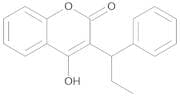
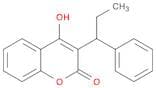
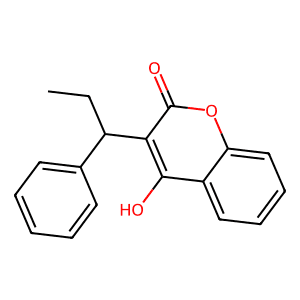
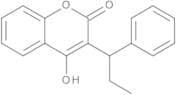
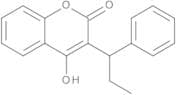
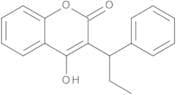
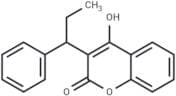
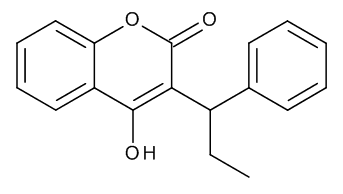
2H-1-Benzopyran-2-one, 4-hydroxy-3-(1-phenylpropyl)-, commonly known as a flavonoid compound, exhibits several notable characteristics. This substance features a chromone backbone, which is a fused benzene and pyrone ring structure, contributing to its aromatic properties. The presence of a hydroxy group at the 4-position enhances its potential for hydrogen bonding and increases its solubility in polar solvents. The phenylpropyl substituent at the 3-position adds to its hydrophobic character, influencing its biological activity and interaction with cellular membranes. This compound is known for its antioxidant properties, which can be attributed to the conjugated double bond system within the chromone structure. Additionally, it may exhibit various pharmacological effects, including anti-inflammatory and anti-cancer activities, making it of interest in medicinal chemistry. Its CAS number, 435-97-2, allows for easy identification in chemical databases, facilitating research and application in various fields, including pharmaceuticals and natural product chemistry.
Formula:C18H16O3
InChI:InChI=1/C18H16O3/c1-2-13(12-8-4-3-5-9-12)16-17(19)14-10-6-7-11-15(14)21-18(16)20/h3-11,13,19H,2H2,1H3
InChI key:InChIKey=DQDAYGNAKTZFIW-UHFFFAOYSA-N
SMILES:C(CC)(C1=C(O)C=2C(OC1=O)=CC=CC2)C3=CC=CC=C3
Synonyms:- (.+-.)-Phenprocoumon
- 3-(1-Phenylpropyl)-4-hydroxycoumarin
- 3-(α-Ethylbenzyl)-4-hydroxycoumarin
- 3-(α-Phenylpropyl)-4-hydroxycoumarin
- 4-Hydroxy-2-oxo-3-(1-phenylpropyl)-2H-chromene
- 4-Hydroxy-3-(1-phenylpropyl)-2H-1-benzopyran-2-one
- <span class="text-smallcaps">DL</span>-3-(α-Ethylbenzyl)-4-hydroxycoumarin
- Bs 7565
- Coumarin, 3-(α-ethylbenzyl)-4-hydroxy-
- DL-3-(α-Ethylbenzyl)-4-hydroxycoumarin
- Falithrom
- Fencumar
- Fenprocoumona
- Liquamar
- Marcoumar
- Marcumar
- Phenprocoumarol
- Phenprocoumarole
- Phenprocoumone
- Phenprocumon
- Ro 1-4849
- 2-hydroxy-3-(1-phenylpropyl)-4H-chromen-4-one
- 4-hydroxy-3-(1-phenylpropyl)coumarin
- 4-hydroxy-3-(1-phenylpropyl)-2H-chromen-2-one
- 2H-1-Benzopyran-2-one, 4-hydroxy-3-(1-phenylpropyl)-
- PHENYLPROPYL-4-HYDROXYCOUMARIN
- Coumarin, 3-(alpha-ethylbenzyl)-4-hydroxy-
- 4-Hydroxy-3-(1-phenylpropyl)-2H-chromen-2-on
- 3-(1'-Phenyl-propyl)-4-oxycoumarin
- 3-(alpha-Ethylbenzyl)-4-hydroxycoumarin
- MARCUMA
- 2-hydroxy-3-[(1S)-1-phenylpropyl]-4H-chroMen-4-one
- Phenprocoumon (Marcumar)
- Phenprocumone
- See more synonyms
Sort by
Purity (%)
0
100
|
0
|
50
|
90
|
95
|
100
Found 11 products.
Phenprocoumon 100 µg/mL in Acetonitrile
CAS:Formula:C18H16O3Color and Shape:Single SolutionMolecular weight:280.32Phenprocoumon
CAS:Phenprocoumon is an antagonist of vitamin K(IC50:1 μM).Formula:C18H16O3Purity:95.79% - 97.98%Color and Shape:Fine White Crystalline Powder SolidMolecular weight:280.32Phenprocoumon
CAS:Controlled ProductApplications Phenprocoumon is known for being an oral anti-coagulant.
Not a dangerous good if item is equal to or less than 1g/ml and there is less than 100g/ml in the package
References Kohl, C. et al.: Drug. Metab. Disp., 28, 161 (2000);Formula:C18H16O3Color and Shape:White To Off-WhiteMolecular weight:280.32Phenprocoumon
CAS:Controlled ProductApplications Phenprocoumon is known for being an oral anti-coagulant.
References Kohl, C. et al.: Drug. Metab. Disp., 28, 161 (2000);Formula:C18H16O3Color and Shape:White To Off-WhiteMolecular weight:280.32Phenprocoumon
CAS:Phenprocoumon is a drug that belongs to the class of coumarin derivatives. It is used as an oral anticoagulant for the prevention and treatment of thrombosis or embolism in patients with atrial fibrillation, chronic deep venous thrombosis, or pulmonary embolism. Phenprocoumon prevents clot formation by inhibiting vitamin K-dependent factors necessary for blood coagulation. This drug may also be used to control bleeding in persons with hemophilia A or B. Phenprocoumon has been shown to decrease the rate of myocardial infarction (heart attack) and mortality rates in patients who have had a previous myocardial infarction. The mechanism by which phenprocoumon works is not well understood but it is known that this drug may interact with other drugs such as nonsteroidal anti-inflammatory drugs (NSAIDs).Formula:C18H16O3Purity:Min. 95%Molecular weight:280.32 g/mol