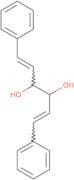
CAS 4403-20-7
:1,6-Diphenyl-1,5-hexadiene-3,4-diol
Description:
1,6-Diphenyl-1,5-hexadiene-3,4-diol, with the CAS number 4403-20-7, is an organic compound characterized by its structure, which features a hexadiene backbone with two phenyl groups attached at the 1 and 6 positions, and hydroxyl groups at the 3 and 4 positions. This compound is typically a solid at room temperature and exhibits properties associated with both aromatic and aliphatic compounds due to its conjugated diene system and the presence of hydroxyl groups. The hydroxyl groups contribute to its potential for hydrogen bonding, influencing its solubility in polar solvents. Additionally, the compound may exhibit interesting optical properties due to its conjugated system, making it relevant in studies of photochemistry and materials science. Its reactivity can be influenced by the presence of the hydroxyl groups, which can participate in various chemical reactions, including oxidation and esterification. Overall, 1,6-Diphenyl-1,5-hexadiene-3,4-diol is of interest in organic synthesis and may have applications in pharmaceuticals or as a precursor in the development of more complex organic materials.
Formula:C18H18O2
InChI:InChI=1S/C18H18O2/c19-17(13-11-15-7-3-1-4-8-15)18(20)14-12-16-9-5-2-6-10-16/h1-14,17-20H
InChI key:InChIKey=AVIIWHKOUNFPIY-UHFFFAOYSA-N
SMILES:C(=CC(C(C=CC1=CC=CC=C1)O)O)C2=CC=CC=C2
Synonyms:- NSC 222804
- Hydrocinnamoin
- 1,6-Diphenyl-1,5-hexadiene-3,4-diol
- 1,5-Hexadiene-3,4-diol, 1,6-diphenyl-
Sort by
Purity (%)
0
100
|
0
|
50
|
90
|
95
|
100
Found 1 products.
Hydrocinnamoin
CAS:<p>Hydrocinnamaldehyde is a reactive aldehyde that is used for the synthesis of other compounds. It can be obtained by catalyzing the oxidative cleavage of cinnamyl alcohol. Hydrocinnamaldehyde is also found in marine environments, where it reacts with oxygen to form an unstable compound called hydrocinnamic acid. Hydrocinnamic acid then undergoes an oxidation-reduction process that converts it to hydrocinnamaldehyde. Hydrocinnamaldehyde is one of two carbene precursors used in the Grubbs reaction, which allows for the selective formation of C-C bonds from alkenes and alkynes. The other carbene precursor, methyllithium, is commercially unavailable and has been replaced by hydrocinnamaldehyde as a more economical alternative in this reaction.<br>Hydrocinnamaldehyde can also be used to synthesize palytoxin, which is a toxic compound found in shellfish such as oysters and clams</p>Formula:C18H18O2Purity:Min. 95%Color and Shape:PowderMolecular weight:266.33 g/mol