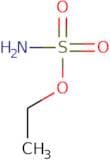
CAS 4403-49-0
:ethyl sulfamate
Description:
Ethyl sulfamate is an organic compound characterized by its sulfamate functional group, which consists of a sulfur atom bonded to an oxygen atom and a nitrogen atom, with an ethyl group attached. It is typically a colorless to pale yellow liquid with a faint odor. Ethyl sulfamate is soluble in water and various organic solvents, making it versatile for different applications. This compound is primarily used in the synthesis of pharmaceuticals and agrochemicals, serving as an intermediate in the production of various biologically active molecules. It exhibits properties such as being a potential inhibitor of certain enzymes, which can be beneficial in medicinal chemistry. However, like many chemical substances, it should be handled with care due to potential toxicity and environmental impact. Safety data sheets should be consulted for proper handling and disposal guidelines. Overall, ethyl sulfamate is an important compound in organic synthesis, contributing to advancements in chemical research and development.
Formula:C2H7NO3S
InChI:InChI=1/C2H7NO3S/c1-2-6-7(3,4)5/h2H2,1H3,(H2,3,4,5)
SMILES:CCOS(=O)(=O)N
Synonyms:- Sulfamic Acid, Ethyl Ester
Sort by
Purity (%)
0
100
|
0
|
50
|
90
|
95
|
100
Found 2 products.
Sulfamic Acid Ethyl Ester (Amidosulfuric Acid Ethyl Ester)
CAS:Formula:C2H7NO3SColor and Shape:White To Off-White SolidMolecular weight:125.14Ethyl sulfamate
CAS:Ethyl sulfamate is a drug that has been developed as an agrochemical and as a potential anticancer agent. It is an aziridine-forming reagent that is used to convert epidermal growth factor (EGF) into EGF-2, which has been shown to have anticancer properties. The mechanism of action of ethyl sulfamate is not yet fully understood, but it appears to be related to its ability to inhibit the kinase activities of protein tyrosine kinases and protein serine/threonine kinases. In addition, ethyl sulfamate inhibits the activity of acid catalyst and enhances the activity of depression in rats. Ethyl sulfamate can also be used as a selective growth factor for erythrocyte progenitor cells in culture.Formula:C2H7NO3SPurity:Min. 95%Molecular weight:125.15 g/mol