CAS 4425-82-5
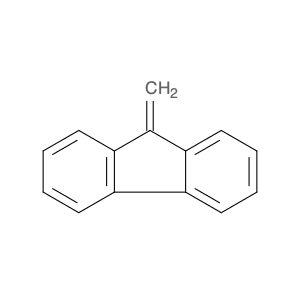
:Dibenzofulvene
Description:
Dibenzofulvene is an organic compound characterized by its unique structure, which consists of two benzene rings fused to a fulvene moiety. This compound is notable for its aromatic properties and the presence of a conjugated system, which contributes to its stability and reactivity. Dibenzofulvene typically appears as a colorless to pale yellow liquid and has a relatively low boiling point, indicating its volatility. It is insoluble in water but soluble in organic solvents, which is common for many aromatic compounds. The compound exhibits interesting chemical behavior, including potential reactivity in electrophilic substitution reactions due to the electron-rich nature of the aromatic rings. Additionally, dibenzofulvene can participate in cycloaddition reactions, making it a subject of interest in synthetic organic chemistry. Its unique structure and properties make it a valuable compound for research in materials science and organic synthesis. Safety precautions should be taken when handling dibenzofulvene, as with many organic compounds, due to potential health hazards associated with exposure.
Formula:C14H10
InChI:InChI=1S/C14H10/c1-10-11-6-2-4-8-13(11)14-9-5-3-7-12(10)14/h2-9H,1H2
InChI key:InChIKey=ZYASLTYCYTYKFC-UHFFFAOYSA-N
SMILES:C=C1C=2C(C=3C1=CC=CC3)=CC=CC2
Synonyms:- 1,2:3,4-Dibenzofulvene
- 9-Methylene-9H-fluorene
- 9-Methylene-fluorene
- 9-Methylenefluorene
- 9-Methylidenefluorene
- 9H-fluorene, 9-methylene-
- Dibenzfulvene
- Dibenzofulvene
- Fluorene, 9-methylene-
- Fluorenylidenemethane
Sort by
Purity (%)
0
100
|
0
|
50
|
90
|
95
|
100
Found 5 products.
9-Methylidenefluorene
CAS:9-Methylidenefluorene is a polycyclic aromatic hydrocarbon that can undergo polymerisation reactions to form π-stacking polymers, and is widely used in biochemical experiments and drug synthesis research.Formula:C14H10Purity:99.93%Color and Shape:SolidMolecular weight:178.239-Methylene-9H-fluorene
CAS:9-Methylene-9H-fluorene is a fluorescent probe that can be used to detect the presence of hydroxyl groups in vitro. It reacts with the hydroxyl group on the substrate film and emits light, which is then detected using a fluorometer. The reaction mechanism is shown below. Fluorophores are often used for sample preparation because they are relatively stable and can be easily removed from the final product. 9-Methylene-9H-fluorene has been shown to enhance cationic polymerization, which can lead to improved efficacy in some applications.Formula:C14H10Purity:Min. 95%Color and Shape:PowderMolecular weight:178.23 g/mol9-Methylidenefluorene
CAS:Stability Light Sensitive
Applications 9-Methylidenefluorene is an analog of 9-Methylfluorene (M305335); a compound that has been shown to be mutagenic in Salmonella typhimurium TA98 and TA100 in the presence of 9000 X g supernantant from Aroclor-induced rats.
Not a dangerous good if item is equal to or less than 1g/ml and there is less than 100g/ml in the package
References Lavoie, E.J., et. al.: Mutat. Res., 91, 167 (1981)Formula:C14H10Color and Shape:Off-White To Light BeigeMolecular weight:178.23