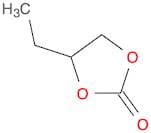
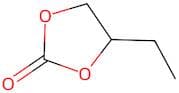
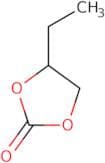
CAS 4437-85-8
:Butylene carbonate
Description:
Butylene carbonate, with the CAS number 4437-85-8, is an organic compound classified as a cyclic carbonate. It is a colorless, odorless liquid that is soluble in water and various organic solvents, making it versatile for different applications. Butylene carbonate is known for its low toxicity and biodegradability, which makes it an environmentally friendly option compared to other solvents. It has a relatively high boiling point and a moderate viscosity, contributing to its stability under various conditions. This compound is primarily used as a solvent in chemical reactions, as well as a plasticizer in polymer formulations. Additionally, butylene carbonate serves as an electrolyte solvent in lithium-ion batteries, enhancing their performance and safety. Its ability to form stable complexes with lithium salts further underscores its significance in energy storage applications. Overall, butylene carbonate is valued for its functional properties and its role in promoting sustainable practices in chemical manufacturing and energy technologies.
Formula:C5H8O3
InChI:InChI=1S/C5H8O3/c1-2-4-3-7-5(6)8-4/h4H,2-3H2,1H3
InChI key:InChIKey=ZZXUZKXVROWEIF-UHFFFAOYSA-N
SMILES:C(C)C1OC(=O)OC1
Synonyms:- (4R)-4-ethyl-1,3-dioxolan-2-one
- (4S)-4-ethyl-1,3-dioxolan-2-one
- 1,2-Butanediol carbonate
- 1,2-Butanediol, cyclic carbonate
- 1,2-Butylene carbonate
- 1,3-Dioxolan-2-one, 4-ethyl-
- 1-Butene carbonate
- 2-Oxo-4-ethyl-1,3-dioxolane
- 4-(Carboxyoxy)Butyl Carbonate
- 4-Ethyl-1,3-dioxolidin-2-one
- Butylene carbonate
- Carbonic acid, cyclic ethylethylene ester
- Carbonic acid, ethylethylene ester
- Jeffsol BC
- See more synonyms
Sort by
Purity (%)
0
100
|
0
|
50
|
90
|
95
|
100
Found 5 products.
4-Ethyl-1,3-dioxolan-2-one
CAS:Formula:C5H8O3Purity:98%Color and Shape:LiquidMolecular weight:116.1152(±)-4-Ethyl-1,3-dioxolan-2-one
CAS:Formula:C5H8O3Purity:>98.0%(GC)Color and Shape:Colorless to Almost colorless clear liquidMolecular weight:116.124-Ethyl-1,3-dioxolan-2-one
CAS:Formula:C5H8O3Purity:98%Color and Shape:LiquidMolecular weight:116.1161,2-Butylene carbonate
CAS:1,2-Butylene carbonate is a film-forming polymer that is used in coating applications. It is also used as an additive to provide water repellency and improve the surface properties of polymers. This compound can be synthesized by the reaction of allyl carbonate with glycol ethers and zirconium oxide catalysts. The carbonyl group in 1,2-butylene carbonate reacts with hydrochloric acid to form the corresponding ester. The activation energies for this reaction are relatively high, which indicates that it has a thermodynamically unfavorable reaction mechanism. This polymer has been shown to have good water permeability and photoelectron properties that make it suitable for use as a protective layer in solar cells.
Formula:C5H8O3Purity:Min. 98 Area-%Color and Shape:Clear LiquidMolecular weight:116.12 g/mol