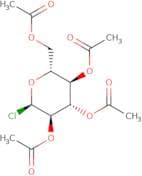
CAS 4451-35-8
:2,3,4,6-tetra-O-acetyl-alpha-D-glucopyranosyl chloride
Description:
2,3,4,6-Tetra-O-acetyl-alpha-D-glucopyranosyl chloride is a derivative of glucose, specifically an acetylated form of the sugar. This compound features four acetyl groups attached to the hydroxyl groups at positions 2, 3, 4, and 6 of the glucopyranose ring, which enhances its lipophilicity and stability compared to unmodified glucose. The presence of the chloride substituent at the anomeric carbon (position 1) makes it a reactive electrophile, allowing it to participate in various chemical reactions, such as glycosylation. This compound is typically used in organic synthesis, particularly in the preparation of glycosides and other carbohydrate derivatives. It is a white to off-white solid, soluble in organic solvents, and its reactivity can be influenced by the acetyl groups, which can be removed under specific conditions to yield the corresponding hydroxyl groups. As with many chlorinated compounds, it should be handled with care due to potential reactivity and toxicity.
Formula:C14H19ClO9
InChI:InChI=1/C14H19ClO9/c1-6(16)20-5-10-11(21-7(2)17)12(22-8(3)18)13(14(15)24-10)23-9(4)19/h10-14H,5H2,1-4H3/t10-,11-,12+,13-,14+/m1/s1
Sort by
Purity (%)
0
100
|
0
|
50
|
90
|
95
|
100
Found 1 products.
2,3,4,6-Tetra-O-acetyl-α-D-glucopyranosyl chloride
CAS:2,3,4,6-Tetra-O-acetyl-a-D-glucopyranosyl chloride (TAOC) is a nuclear magnetic resonance (NMR) probe that has been used to study the structure of nuclei. It is synthesised by reacting acetyl chloride with sucrose in a reaction catalyzed by sodium hydroxide. The compound can be detected in quadrupole and resonance spectroscopy due to its high sensitivity to nuclear magnetic resonance. This NMR probe is typically used to study the structures of nuclei or for the analysis of polysaccharides.
Formula:C14H19ClO9Purity:Min. 95%Color and Shape:PowderMolecular weight:366.8 g/mol