CAS 446-59-3
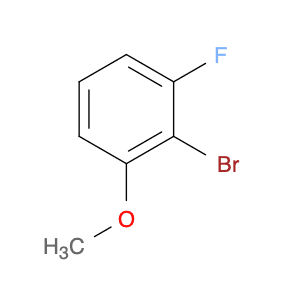
:2-Bromo-3-fluoroanisole
Description:
2-Bromo-3-fluoroanisole, with the CAS number 446-59-3, is an organic compound that belongs to the class of halogenated anisoles. It features a methoxy group (-OCH3) attached to a benzene ring, which also bears a bromine atom at the second position and a fluorine atom at the third position. This compound is typically a colorless to pale yellow liquid or solid, depending on its purity and temperature. It is characterized by its moderate polarity due to the presence of both halogen substituents and the methoxy group, which can influence its reactivity and solubility in various solvents. 2-Bromo-3-fluoroanisole is often used in organic synthesis as an intermediate for the preparation of more complex molecules, including pharmaceuticals and agrochemicals. Its halogen substituents can participate in nucleophilic substitution reactions, making it a valuable building block in synthetic chemistry. Additionally, it may exhibit specific biological activities, although detailed studies on its biological properties may be limited.
Formula:C7H8FNO
InChI:InChI=1/C7H8FNO/c1-10-6-4-2-3-5(8)7(6)9/h2-4H,9H2,1H3
SMILES:COc1cccc(c1N)F
Sort by
Purity (%)
0
100
|
0
|
50
|
90
|
95
|
100
Found 4 products.
2-bromo-1-fluoro-3-methoxybenzene
CAS:Formula:C7H6BrFOPurity:98%Color and Shape:SolidMolecular weight:205.02432-Bromo-3-fluoroanisole
CAS:2-Bromo-3-fluoroanisoleFormula:C7H6BrFOPurity:99%Color and Shape: off-white crystalsMolecular weight:205.02g/mol2-bromo-1-fluoro-3-methoxybenzene
CAS:2-bromo-1-fluoro-3-methoxybenzene (2BrFM) is a modulator that has been shown to be active against the enzyme d159687. It is an analog of 2-bromo-1,3-difluoroacetophenone, which is a known modulator of d159687. This compound has been shown to be effective in sequential and combinatorial approaches as well as when coupled with other modulators. 2BrFM has also been found to be an allosteric modulator, which alters the shape or conformation of the active site in order to either inhibit or activate the binding of substrates. The allosteric modulation profiles for this compound have not yet been fully elucidated.
Formula:C7H6BrFOPurity:Min. 95%Molecular weight:205.02 g/mol