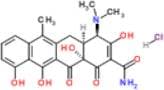
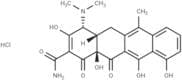
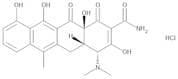
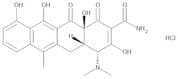
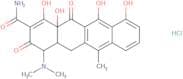
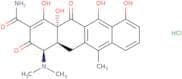
![(1R,4aS,12aS)-3-[amino(hydroxy)methylidene]-4a,6,7-trihydroxy-N,N,11-trimethyl-2,4,5-trioxo-1,2,3,…](/_next/image/?url=https%3A%2Fstatic.cymitquimica.com%2Fcas-image%2Fthumb-webp%2F239602-1r-4as-12as-3-amino-hydroxy-methylidene-4a-67-trihydroxy-n-n-11-trimethyl-245-trioxo-12344a-51212a-octahydrotetracen-1-aminium.webp&w=3840&q=75)
CAS 4465-65-0
:(1R,4aS,12aS)-3-[amino(hydroxy)methylidene]-4a,6,7-trihydroxy-N,N,11-trimethyl-2,4,5-trioxo-1,2,3,4,4a,5,12,12a-octahydrotetracen-1-aminium
Description:
The chemical substance with the name "(1R,4aS,12aS)-3-[amino(hydroxy)methylidene]-4a,6,7-trihydroxy-N,N,11-trimethyl-2,4,5-trioxo-1,2,3,4,4a,5,12,12a-octahydrotetracen-1-aminium" and CAS number 4465-65-0 is a complex organic compound characterized by its intricate polycyclic structure and multiple functional groups. It features a tetracyclic framework with several hydroxyl (-OH) and amino (-NH2) groups, contributing to its potential solubility in polar solvents and biological activity. The presence of trioxo groups indicates a high degree of oxidation, which may influence its reactivity and stability. The specific stereochemistry, denoted by the R and S configurations, suggests that the compound may exhibit chiral properties, potentially affecting its interactions in biological systems. This compound may be of interest in medicinal chemistry due to its structural complexity and the presence of functional groups that could participate in various biochemical interactions. However, detailed studies would be necessary to fully understand its properties, reactivity, and potential applications.
Formula:C22H23N2O7
InChI:InChI=1/C22H22N2O7/c1-8-9-5-4-6-12(25)13(9)17(26)14-10(8)7-11-16(24(2)3)18(27)15(21(23)30)20(29)22(11,31)19(14)28/h4-6,11,16,25-26,30-31H,7,23H2,1-3H3/p+1/t11-,16+,22-/m0/s1
Sort by
Purity (%)
0
100
|
0
|
50
|
90
|
95
|
100
Found 9 products.
4-EPIANHYDROTETRACYCLINE HYDROCHLORIDE CRS
CAS:4-EPIANHYDROTETRACYCLINE HYDROCHLORIDE CRSFormula:C22H23ClN2O7Color and Shape:Orange. Powder.Molecular weight:462.88024-Epianhydrotetracycline Hydrochloride
CAS:Tetracyclines and their derivatives; salts thereofFormula:C22H22N2O7·HClColor and Shape:Dark Yellow Brown SolidMolecular weight:426.14274-Epianhydrotetracycline hydrochloride
CAS:EATC, a tetracycline byproduct, combats Pseudomonas to E. coli with MIC50s of 0.75-16 mg/L.Formula:C22H23ClN2O7Color and Shape:SolidMolecular weight:462.884-Epianhydrotetracycline hydrochloride
CAS:Controlled ProductFormula:C22H22N2O7·ClHColor and Shape:NeatMolecular weight:462.88Tetracycline EP Impurity D HCl (Chlortetracycline EP Impurity I HCl , Lymecycline EP Impurity D HCl , 4-Epianhydrotetracycline HCl )
CAS:Formula:C22H22N2O7·HClMolecular weight:426.43 36.464-Epianhydrotetracycline Hydrochloride Hydrate (>85%)
CAS:Controlled ProductApplications An antibiotic derived from Tetracycline. Studies have shown that this derivative can have a 250-fold higher toxicity depending on the system under study. This compound is a contaminant of emerging concern (CECs).
References Simmons, D., et al.: J. Pharm. Sci., 55, 1313 (1966), Paemen, L., et al.: Biochem. Pharmacol., 52, 105 (1996),Formula:C22H22N2O7·HCl·H2OPurity:>85%Color and Shape:NeatMolecular weight:480.94-Epianhydrotetracycline hydrochloride
CAS:4-Epianhydrotetracycline hydrochloride is a chemically modified antibiotic derivative, originating from the structural transformation of tetracycline. It is derived through epimerization and dehydration processes, which alter the parent compound's structure.Formula:C22H23ClN2O7Purity:Min. 95%Molecular weight:462.9 g/mol4-Epianhydrotetracycline hydrochloride hydrate
CAS:4-Epianhydrotetracycline hydrochloride hydrate is a chemical compound that inhibits the activation of protein kinase C (PKC) and blocks the apoptosis pathway. It has been shown to induce apoptosis in prostate cancer cells and also inhibits the proliferation of human microvessel endothelial cells. 4-Epianhydrotetracycline hydrochloride hydrate is stable in both human serum and wastewater, which makes it an ideal drug for treating many types of cancers. It is also used in pharmaceutical drugs as a cytochalasin, which are used to treat angina pectoris by reducing oxygen uptake by erythrocytes, thereby inhibiting oxidative phosphorylation. 4-Epianhydrotetracycline hydrochloride hydrate prevents mitochondrial cytochrome c release, thus blocking the apoptotic pathway in cells. This chemical compound may act as a regulatory molecule that affects energy metabolism and epidermal growth factor (EGF)Formula:C22H23ClN2O7Purity:Min. 95%Molecular weight:462.88 g/mol