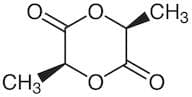
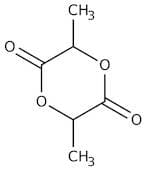
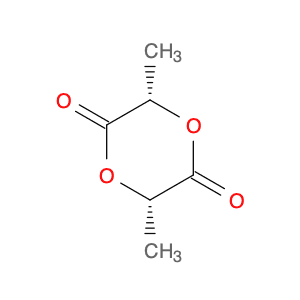
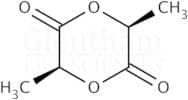
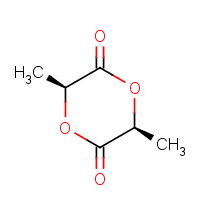
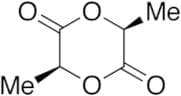
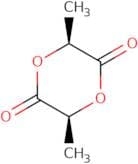
CAS 4511-42-6
:L-Lactide
- (-)-<span class="text-smallcaps">L</span>-Dilactide
- (3R,6S)-3,6-dimethyl-1,4-dioxane-2,5-dione
- (3S)-cis-3,6-Dimethyl-1,4-dioxane-2,5-dione
- (3S,6S)-3,6-Dimethyl-1,4-dioxane-2,5-dione
- (S,S)-3,6-Dimethyl-1,4-dioxane-2,5-dione
- 1,4-Dioxane-2,5-dione, 3,6-dimethyl-, (3S,5S)-
- 1,4-Dioxane-2,5-dione, 3,6-dimethyl-, (3S,6S)-
- 1,4-Dioxane-2,5-dione, 3,6-dimethyl-, (3S-cis)-
- 3,6-Dimethyl-1,4-Dioxane-2,5-Dione
- <span class="text-smallcaps">L</smallcap>,<smallcap>L</span>-Dilactide
- <span class="text-smallcaps">L</smallcap><smallcap>L</span>-Lactide
- <span class="text-smallcaps">L</span>-(-)-Lactide
- Esun LA 99
- L-Lactide
- Lactide
- Lumilact L
- PuraLact L
- Purac TL
- Puralact B 3
- Purasorb L
- Scolat AL
- p-Dioxane-2,5-dione, 3,6-dimethyl-, <span class="text-smallcaps">L</span>-
- See more synonyms
L-(-)-Lactide
CAS:Formula:C6H8O4Purity:>98.0%(T)Color and Shape:White to Almost white powder to crystalMolecular weight:144.13L-Lactide, 98+%
CAS:L-Lactide upon polymerization gives poly(lactic acid), which finds many useful properties like biodegradable and nontoxic to the human body and the environment. Its polymer, poly-l-lactide is utilized in the repairing of orbital posterior floor fracture. Further, it is used as biomedical materialsFormula:C6H8O4Purity:98+%Color and Shape:White, Crystalline powderMolecular weight:144.13(3S,6S)-3,6-dimethyl-1,4-dioxane-2,5-dione
CAS:Formula:C6H8O4Purity:97%Color and Shape:SolidMolecular weight:144.1253L-Lactide
CAS:Formula:C6H8O4Purity:(GC) ≥ 99.0%Color and Shape:White crystals or crystalline powderMolecular weight:144.13L-(-)-Lactide
CAS:L-(-)-LactideFormula:C6H8O4Purity:98%Color and Shape: white solidMolecular weight:144.13g/molL-(-)-Lactide
CAS:Applications L-(-)-Lactide is a cyclic lactic acid derivative used in the ring-opening polymerization of Poly-L-lactic acid (PLLA), which is commonly found in biodegradable plastics. Polymers derived from L-(-)-Lactide also provide a therapeutic use in the field of prosthetics as they do not have any adverse effects on proliferation and differentiation of bone cells.
References Nakamura, T. et al.: J. Biomed. Mat. Res., 23, 1115 (1999); Otto, T.E. et al.: J. Biomed. Mat. Res., 32, 513 (1996); Kale, G. et al.: Pach. Technol. Sci., 20, 49 (2007);Formula:C6H8O4Color and Shape:NeatMolecular weight:144.13L-(-)-Lactide
CAS:L-(-)-lactide is a compound that consists of an intramolecular hydrogen bond between the hydroxyl group and the carbonyl group. It is used in the synthesis of poly(d,l-lactide) (PDLLA), which serves as a growth factor for cells in culture. The hydroxy groups on PDLLA can be polymerized using cationic polymerization to form poly(d, l-lactide) (PDLL). This polymer has been shown to have potential use as both a scaffold material for tissue engineering and a drug delivery system. FTIR spectroscopy has shown that L-(-)-Lactide has two distinct absorption peaks at 1350 cm-1 and 1410 cm-1. Both peaks are attributed to stretching vibrations of the carbonyl groups. These two peaks are also indicative of its intramolecular hydrogen bond with the hydroxyl group, where the peak at 1350 cm-
Formula:C6H8O4Purity:Min. 98%Color and Shape:White PowderMolecular weight:144.13 g/mol(3S,6S)-3,6-Dimethyl-1,4-dioxane-2,5-dione
CAS:Formula:C6H8O4Purity:95%Color and Shape:Liquid, No data available.Molecular weight:144.126