CAS 45234-13-7
:N(alpha)-boc-L-citrulline
Description:
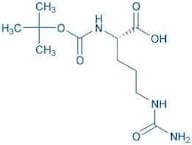
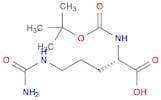
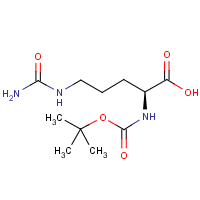
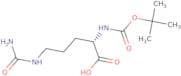
N(alpha)-Boc-L-citrulline is a derivative of the amino acid citrulline, characterized by the presence of a tert-butyloxycarbonyl (Boc) protecting group on the alpha-amino group. This modification enhances its stability and solubility, making it useful in peptide synthesis and other biochemical applications. The compound is typically a white to off-white solid and is soluble in organic solvents such as dimethyl sulfoxide (DMSO) and methanol, but less soluble in water. N(alpha)-Boc-L-citrulline plays a significant role in the synthesis of peptides, particularly those that require the incorporation of non-standard amino acids. It is also used in research related to nitric oxide production, as citrulline is a precursor to arginine, which is involved in the synthesis of nitric oxide. The compound's molecular structure includes a side chain characteristic of citrulline, which contributes to its biological activity. Overall, N(alpha)-Boc-L-citrulline is a valuable compound in both synthetic and medicinal chemistry.
Formula:C11H21N3O5
InChI:InChI=1/C11H21N3O5/c1-11(2,3)19-10(18)14-7(8(15)16)5-4-6-13-9(12)17/h7H,4-6H2,1-3H3,(H,14,18)(H,15,16)(H3,12,13,17)/t7-/m0/s1
SMILES:CC(C)(C)OC(=N[C@@H](CCCNC(=N)O)C(=O)O)O
Synonyms:- Boc-Cit-OH
- N~2~-(tert-butoxycarbonyl)-N~5~-carbamoyl-L-ornithine
Sort by
Purity (%)
0
100
|
0
|
50
|
90
|
95
|
100
Found 8 products.
Boc-Cit-OH
CAS:Bachem ID: 4000079.
Formula:C11H21N3O5Purity:> 99%Color and Shape:White PowderMolecular weight:275.31Ref: IN-DA003OHC
1kgTo inquire500gTo inquire250mg25.00€1g45.00€5g74.00€10g132.00€25g156.00€50g268.00€100g337.00€250g680.00€Boc-L-citrulline
CAS:Controlled ProductFormula:C11H21N3O5Purity:~90%Color and Shape:NeatMolecular weight:275.3(S)-2-((tert-Butoxycarbonyl)amino)-5-ureidopentanoic acid
CAS:Formula:C11H21N3O5Purity:95%Color and Shape:White to pale yellow powderMolecular weight:275.305Boc-L-citrulline
CAS:Boc-L-citrulline is a sensor molecule that has been shown to be sensitive to changes in the physiological environment. It is activated by citrullination and undergoes an isosteric change when arginine residues are mutated. The sensor kinetics are dependent on the number of arginine residues, which can be compensated for by adding additional sensors. Boc-L-citrulline has been shown to function as a mechanistic probe for channel activation, which leads to downstream effects such as calcium flux and phosphorylation cascades. This molecule is also functionally similar to arginine because it binds with high affinity to both glutamine synthetase and glutamate dehydrogenase.
Formula:C11H21N3O5Purity:Min. 95%Color and Shape:PowderMolecular weight:275.3 g/mol