CAS 4576-90-3
:3-Isothiazolecarboxylic acid
Description:
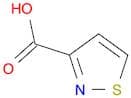
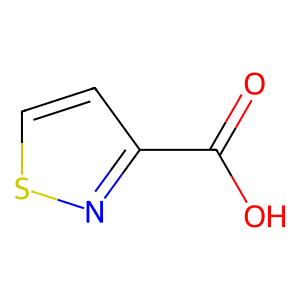
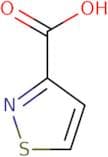
3-Isothiazolecarboxylic acid is a heterocyclic organic compound characterized by the presence of both an isothiazole ring and a carboxylic acid functional group. The isothiazole ring consists of a five-membered structure containing both sulfur and nitrogen atoms, which contributes to its unique chemical properties. This compound typically exhibits moderate solubility in polar solvents due to the presence of the carboxylic acid group, which can engage in hydrogen bonding. It is known for its potential applications in various fields, including pharmaceuticals and agrochemicals, owing to its biological activity and ability to act as a building block in synthetic chemistry. The compound may also exhibit antimicrobial properties, making it of interest in the development of new antimicrobial agents. Additionally, its reactivity can be influenced by the functional groups attached to the isothiazole ring, allowing for further derivatization and modification in chemical synthesis. Overall, 3-Isothiazolecarboxylic acid is a versatile compound with significant implications in both research and industrial applications.
Formula:C4H3NO2S
InChI:InChI=1/C4H3NO2S/c6-4(7)3-1-2-8-5-3/h1-2H,(H,6,7)
SMILES:c1csnc1C(=O)O
Synonyms:- Isothiazole-3-carboxylic acid
- 1,2-Thiazole-3-Carboxylic Acid
Sort by
Purity (%)
0
100
|
0
|
50
|
90
|
95
|
100
Found 5 products.
Isothiazole-3-carboxylic acid
CAS:Formula:C4H3NO2SPurity:95%Color and Shape:SolidMolecular weight:129.1371Isothiazole-3-carboxylic acid
CAS:Isothiazole-3-carboxylic acidFormula:C4H3NO2SPurity:95%Color and Shape: beige solidMolecular weight:129.14g/molIsothiazole-3-carboxylic acid
CAS:Formula:C4H3NO2SPurity:95%Color and Shape:SolidMolecular weight:129.13Isothiazole-3-carboxylicacid
CAS:Isothiazole-3-carboxylicacid is a nitro compound that is found in biocides, such as insecticides and fungicides. It reacts with nucleophiles by undergoing nucleophilic attack to form an amide. This reaction scheme can be seen when the nitro group reacts with water to form an amide. The nervous system diseases are thought to be caused by the inhibition of neurotransmitter release at nerve synapses by blocking the ion channels that transport sodium ions into cells.
Formula:C4H3NO2SPurity:Min. 95%Molecular weight:129.14 g/mol